What Counts as a Night Wedding (and Why Timing Matters More Than You Think)?
A night wedding typically starts after sunset, usually between 7 and 9 PM depending on season and location, requiring artificial lighting for both visibility and photography.
Most couples who say they want a night wedding actually picture a sunset ceremony with evening reception. There’s nothing wrong with that, but a true night wedding is a different animal. It means your ceremony happens in darkness, your vows are spoken under artificial light, and your entire event infrastructure changes accordingly. Understanding where your vision falls on the spectrum between golden hour and full darkness shapes every decision that follows.
The timing distinction matters because 76% of U.S. weddings take place between May and October [Source: Loren Jackson Photography], when sunsets in popular destinations range from 7:00 PM to 8:30 PM. That seasonal window determines whether your 7 PM ceremony starts in twilight or true night.
The ‘Golden Hour’ vs. True Night: Where Most Couples Actually Land
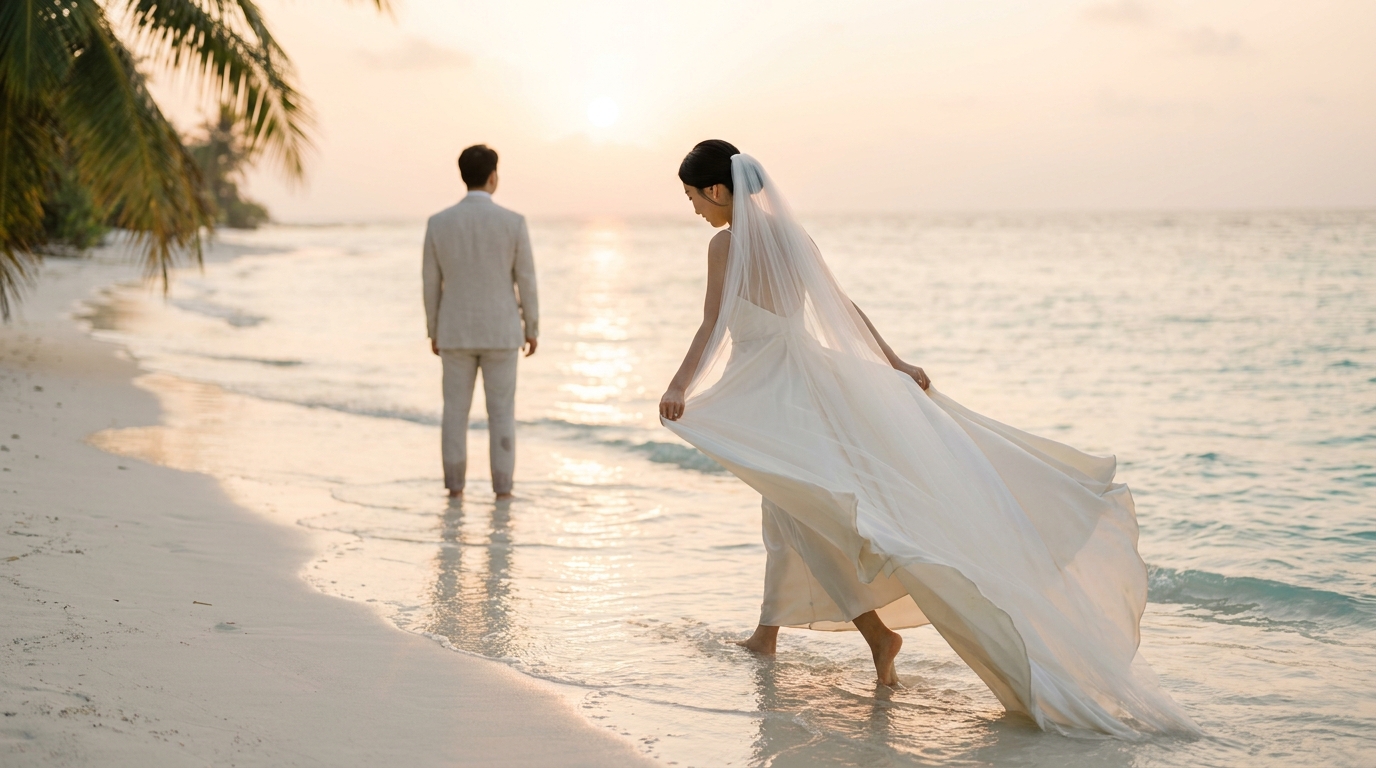
Golden hour, the 30 to 60 minutes before and after sunset, delivers that warm, cinematic glow without requiring professional lighting. True night starts roughly 45 minutes after sunset, when ambient light drops below usable levels. Most couples land somewhere in between: a ceremony that begins in twilight and transitions to darkness during the reception. If you want a ceremony under the stars, you’re planning for full darkness, and that requires a fundamentally different approach to lighting, photography, and guest logistics.
How Sunset Times Shift by Season (and Why December Weddings Start Earlier)
October and June are the two most popular wedding months, each accounting for 16% of weddings, with May at 14% [Source: Kande Photo Booths]. Fall is the most popular season overall, with 35% of couples marrying between September and November. Earlier sunsets in fall and winter mean even a 4 PM ceremony can transition into a nighttime atmosphere, giving you dramatic lighting opportunities without a late start.
Worth noting: 71% of weddings in 2025 lasted two to three days, incorporating rehearsal dinners, welcome receptions, and afterparties [Source: Woman Getting Married]. Multi-day formats are expected to consolidate as the new standard in 2026, which means your evening wedding ceremony can be one piece of a larger celebration rather than the entire event.
| Destination | Summer Sunset (June) | Winter Sunset (Dec) | True Night Starts |
|---|---|---|---|
| Cancun, Mexico | ~7:25 PM | ~5:35 PM | 45–60 min after sunset |
| Hawaii (Maui) | ~7:15 PM | ~5:50 PM | 45–60 min after sunset |
| Santorini, Greece | ~8:45 PM | ~5:10 PM | 45–60 min after sunset |
| Punta Cana, DR | ~7:15 PM | ~6:05 PM | 45–60 min after sunset |
| Bali, Indonesia | ~6:00 PM | ~6:20 PM | 45–60 min after sunset |
Notice how Bali’s near-equatorial position keeps sunset times remarkably consistent year-round, while Santorini’s summer sunsets push past 8:45 PM. Your destination choice directly determines your timeline.
What Are the Real Benefits of a Night Wedding?
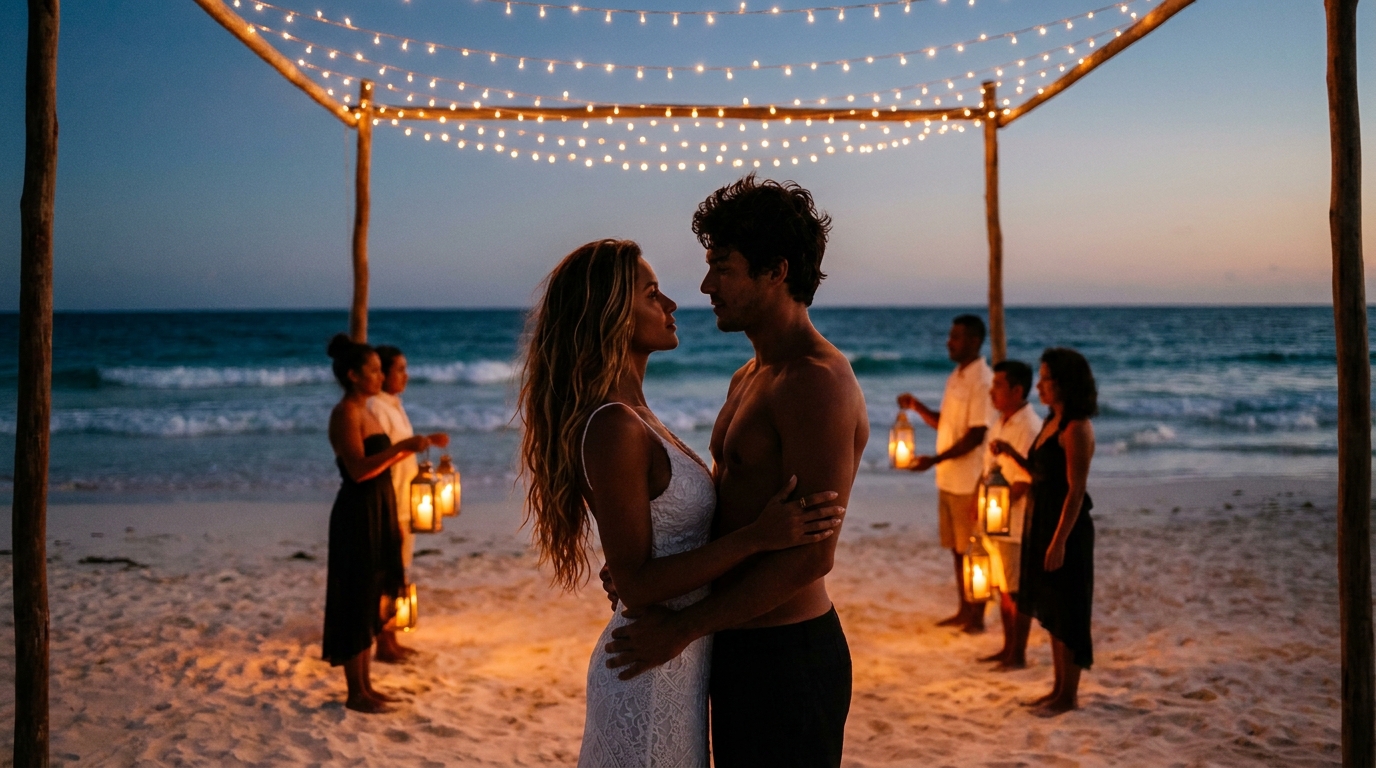
Night weddings offer cooler temperatures, dramatic lighting possibilities, and a built-in transition from ceremony to party atmosphere that daytime events struggle to replicate.
Temperature Relief: Why 8 PM Beats 4 PM in Tropical Climates
In Cancun, afternoon temperatures in June hover around 90°F at 4 PM but drop to roughly 79–82°F by 8 PM. In Hawaii, the difference is typically 8–10°F between mid-afternoon and evening. For guests in formal attire standing on a beach, that temperature drop isn’t trivial. It’s the difference between visible perspiration in photos and genuine comfort. Evening ceremonies in tropical climates eliminate the need for shade structures, misting fans, and the constant worry about heat-related discomfort among older guests.
Lighting Drama: What You Can Do After Dark That Daylight Won’t Allow
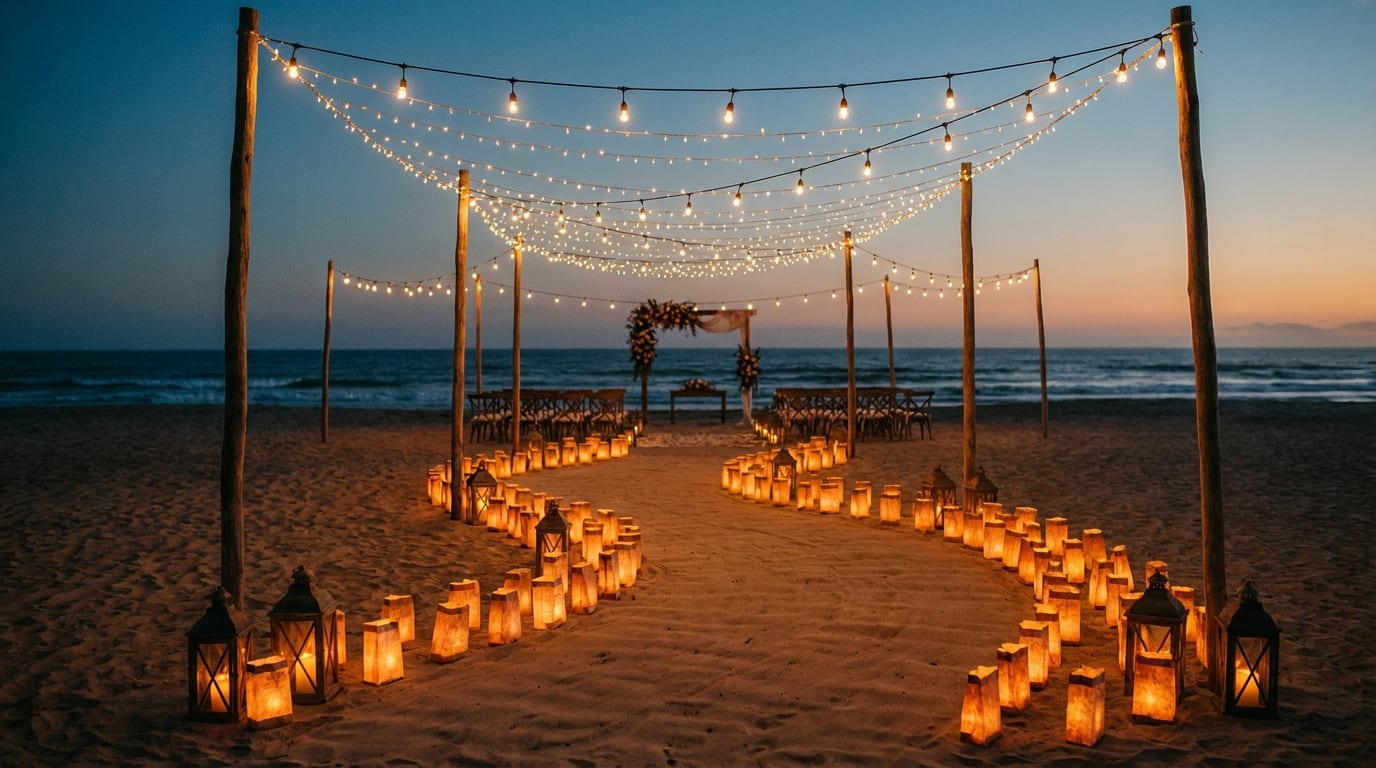
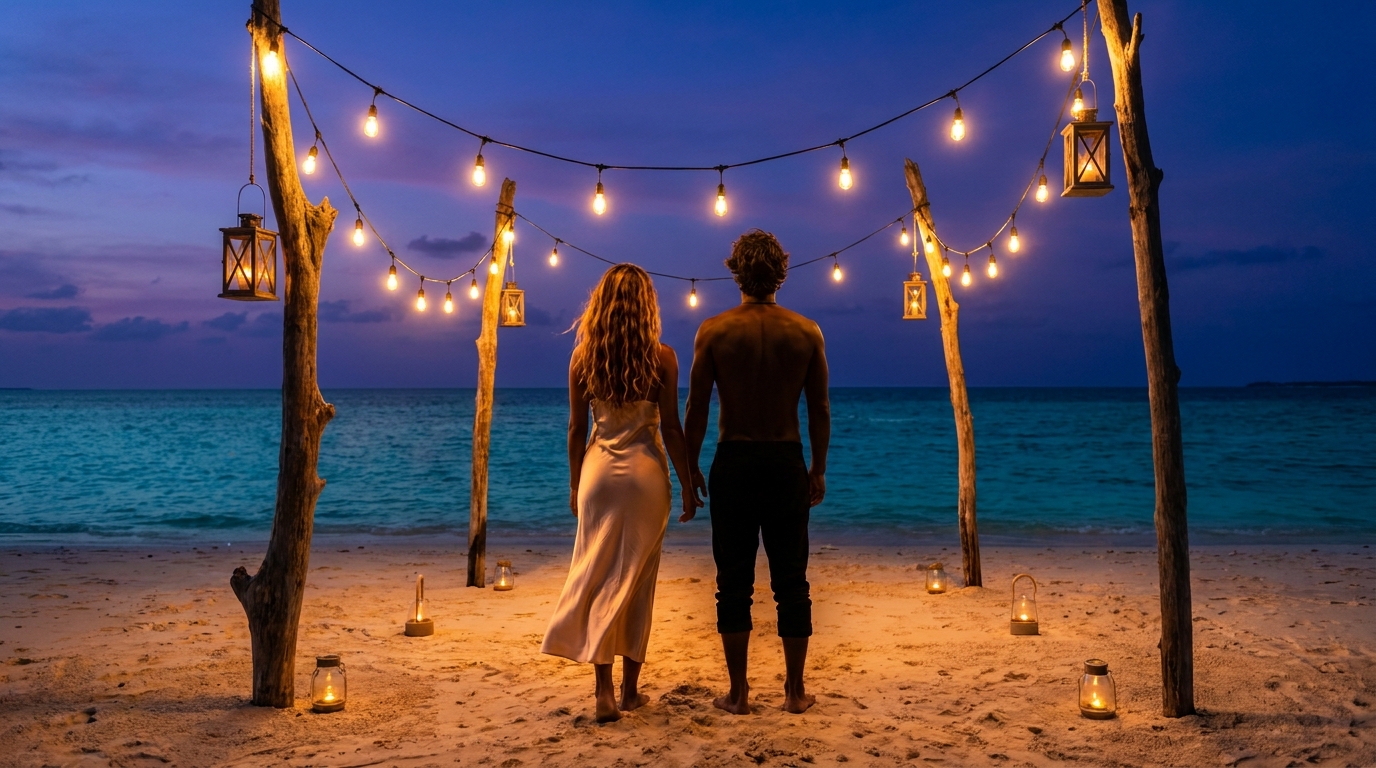
Candles, uplighting, string lights, lanterns, sparklers, and fireworks all lose their visual impact in daylight. After dark, these elements become the visual architecture of your event. Wedding planners consistently note that night settings create a more dramatic and intimate aesthetic that daylight simply cannot replicate [Source: Wedding Chicks]. You’re essentially painting with light, and darkness is your canvas.
Cost Considerations: When Night Timing Actually Saves Money
Some venues offer lower rates for evening-only bookings because they can host a daytime event and an evening event on the same day. You may also save on floral costs, since dramatic lighting reduces the need for elaborate centerpieces. However, these savings are often offset by lighting rental costs. The net financial impact depends on your specific venue and design vision. Costs vary significantly by destination and vendor.
What Makes Night Weddings Harder to Execute?
Night weddings require professional lighting for visibility and photos, careful guest navigation planning, potential permit restrictions, and tighter vendor coordination for setup timing.
The Lighting Investment: What You Actually Need (and What It Costs)
The average U.S. wedding costs about $33,000, with destination weddings averaging $39,000 [Source: The Knot]. Couples typically underestimate their ceremony and reception budget by nearly 45% [Source: Wedding Planner Institute], and night weddings are particularly prone to this because lighting costs are easy to overlook. Professional uplighting packages for a nighttime beach wedding typically run $1,200 to $3,500, depending on the number of fixtures and the complexity of the design. Add pathway lighting, a generator for remote beach locations, and a lighting technician for the duration of the event, and you’re looking at a meaningful line item.
Guest Safety and Comfort: Pathways, Seating, and Temperature Management
Darkness creates tripping hazards on uneven terrain, especially on sand. You’ll need illuminated pathways from parking areas to the ceremony site, lit walkways to restrooms, and enough ambient light around seating areas for older guests to navigate safely. In tropical destinations, temperatures can drop enough after 9 PM to warrant pashminas or blankets for guests, particularly if there’s a sea breeze.
Vendor Logistics: Why Setup Windows Get Tighter After Dark
89% of event professionals reported staffing shortages directly affected their ability to deliver events in the past year, and the hospitality industry is projected to operate at 18% below required staffing levels in 2026 [Source: Wedy App]. Night weddings compound this pressure. Vendors need to set up lighting and test power systems before darkness falls, which compresses the setup window. Wedding venues take an average of 47 hours to respond to new inquiries, with 68–72% of venue inquiries arriving outside business hours [Source: WedyPro]. This communication lag becomes more problematic when you’re coordinating the tighter timelines that after dark weddings demand.
How Do You Light a Night Wedding Without It Looking Like a Construction Site?
Effective night wedding lighting layers ambient uplighting, focused aisle and table lighting, and soft overhead string lights, typically costing $1,200 to $3,500 for professional installation.
The Three-Layer Lighting System That Actually Works
Professional lighting designers use a three-layer approach. The first layer is ambient perimeter lighting: uplights placed around the event space to create a warm glow. One professional guide suggests one uplight per 150 square feet of space, so a 3,000-square-foot area needs about 20 uplights for balanced coverage [Source: Junebug Weddings]. The second layer is task lighting: pinspots on tables and centerpieces (one per table), focused light on the altar, and illumination on the cake and bar. The third layer is decorative overhead lighting: string lights, chandeliers, or lanterns that create visual interest above eye level.
For power planning, a medium-sized outdoor wedding of about 100 guests may need approximately 10,300 watts total for lighting, catering, sound, and other systems, with lighting alone accounting for roughly 1,500 to 2,000 watts [Source: Alamo Wedding Events Center]. Professionals recommend adding a 10–20% buffer and loading circuits to no more than 80% capacity to avoid flicker and overloads.
String Lights vs. Uplighting vs. Lanterns: What Each Does Best
String lights create a canopy effect overhead and work best for defining the reception space. Uplighting washes walls, trees, or architectural features in color and sets the overall mood. Lanterns provide intimate, table-level warmth but don’t throw enough light for photography. The best night weddings combine all three. Avoid relying solely on candles for a nighttime beach wedding, as wind will defeat you.
Working With Your Photographer: Lighting for Humans vs. Cameras
Color temperature matters enormously. For outdoor and evening weddings, planners advise 2,700–3,000K for string lights, lanterns, and perimeter uplights, and 3,000–3,500K for key lights on faces, the altar, and speeches [Source: Alamo Wedding Events Center]. Mixing very cool white (4,000–6,000K) with warm white creates a patchy, utilitarian look. Coordinate with your photographer before finalizing your lighting plan. What looks beautiful to the eye can photograph poorly if color temperatures clash.
What’s the Ideal Timeline for a Night Wedding?
Most successful night weddings start ceremonies 30 to 60 minutes after sunset, allowing twilight photos before full darkness, with receptions running 9 PM to midnight.
The Sunset Buffer: Why Starting Right at Sunset Rarely Works
Starting your ceremony at the exact moment of sunset means guests are staring directly into the setting sun during the processional. It also means your photographer is fighting rapidly changing light conditions throughout the ceremony. A 30 to 60 minute buffer after sunset gives you the best of both worlds: soft twilight for the ceremony’s opening moments and a transition to dramatic artificial lighting as vows are exchanged. If you’re planning a Cancun wedding, a June ceremony start of 8:00 PM captures this window perfectly.
Cocktail Hour Placement: Before or After the Ceremony?
For night weddings, placing cocktail hour before the ceremony is increasingly popular. Guests arrive at 6:30 or 7:00 PM, enjoy drinks and appetizers during golden hour (when photos of the couple are also being taken), and then gather for the ceremony as darkness falls. This eliminates the awkward gap where guests sit in the dark waiting for the reception to begin.
Reception Flow: How Night Timing Changes Your Schedule
A typical night wedding timeline runs: guest arrival and cocktails at 7:00 PM, ceremony at 8:00 PM, dinner at 9:00 PM, dancing from 10:00 PM to midnight. This compressed schedule means your caterer, DJ, and coordinator need to execute transitions quickly. Build 15-minute buffers between each phase. If your venue has noise restrictions (common in residential areas and many resorts), confirm the hard stop time before committing to a late start.
Do Night Weddings Work on the Beach?
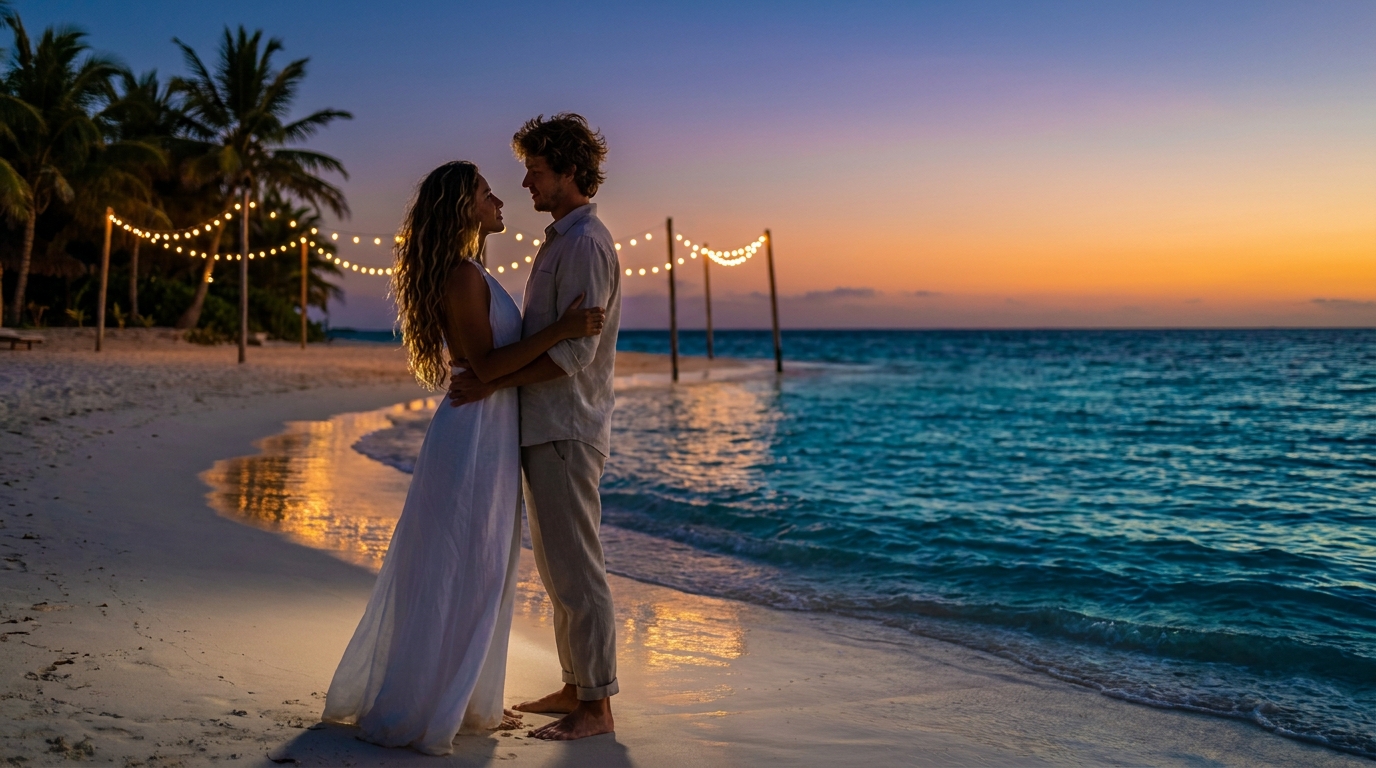
Beach night weddings work well with permit approval, professional lighting, clear guest pathways, and backup plans for wind affecting candles and decor.
Permit Reality: What Most Beach Jurisdictions Actually Allow After Dark
Beach event permits or access fees typically run $250 to $450 in many U.S. jurisdictions [Source: The Knot]. However, many beaches impose restrictions on after-dark events, including limits on music volume, alcohol service, guest count, and open flames. Some beaches close entirely after sunset. In Mexico, beach permits vary by municipality. Tulum’s beach regulations have tightened in recent years, with some areas restricting amplified sound after 10 PM. Always confirm after-dark policies directly with the local permitting authority, not just your resort’s wedding coordinator.
Wind and Open Flame: Why Candles Fail (and What Works Instead)
Open flame on a beach at night is a losing battle. Even moderate coastal breezes will extinguish unprotected candles within minutes, and many beach jurisdictions prohibit open flames entirely. LED candles have improved dramatically and now produce a convincing flicker. Battery-powered lanterns, LED string lights on weighted poles, and uplighting powered by a generator placed upwind are all more reliable alternatives for a nighttime beach wedding.
Sound Considerations: How Darkness Affects Acoustics and Music
Sound carries differently at night. Cooler air and reduced ambient noise mean your music and vows travel farther, which is both an advantage (guests can hear) and a potential problem (neighbors and other resort guests can also hear). A wireless microphone for the officiant is non-negotiable for a night beach ceremony. Directional speakers pointed toward your guests rather than omnidirectional systems help contain sound and reduce complaints.
How Do Night Weddings Affect Your Photography?
Night weddings require photographers experienced in off-camera flash and low-light shooting, with most couples scheduling a pre-ceremony golden hour portrait session.
The Photographer Skill Gap: Why Not Every Shooter Can Handle Night Events
30% of couples now request nighttime photography with long exposures as part of their coverage [Source: World Metrics], and about 49% want golden-hour or nighttime golden-hour shots. Yet not every destination wedding photographer has the equipment or experience to deliver. Night photography requires off-camera flash systems, high-ISO camera bodies, fast lenses (f/1.4 to f/2.8), and the skill to balance flash with ambient light so images feel atmospheric rather than flat. When interviewing photographers, ask specifically for full galleries from after-dark events, not just two or three curated shots.
The Golden Hour Portrait Session: Why Most Couples Do This Separately
A typical full-day wedding involves 2,000 to 4,000 raw frames, yielding 400 to 800 edited photos for a single-photographer package [Source: Matt Ryle Photography]. For night weddings, the most reliable approach is scheduling a separate portrait session during golden hour, 30 to 60 minutes before sunset, while guests enjoy cocktails. This guarantees you get those warm, naturally lit couple portraits regardless of how the nighttime lighting performs.
What to Expect in Your Photo Gallery: Realistic Night Wedding Results
Night wedding galleries look fundamentally different from daytime ones. Expect deeper shadows, more dramatic contrast, and a moodier overall aesthetic. Backgrounds will be darker, and details in unlit areas will be lost. This is a feature, not a flaw, but it’s important to set expectations. If you want bright, airy photos of every table arrangement, a night wedding won’t deliver that. What you will get is cinematic, intimate imagery with a strong sense of atmosphere.
What Should Guests Know About Attending a Night Wedding?
Night wedding guests need clear arrival instructions, appropriate attire guidance for cooler evening temperatures, and transportation details for after-dark departure.
Communication Essentials: What to Include in Your Invitations
Your invitation suite should include the exact ceremony start time, a note about the outdoor evening setting, and explicit transportation details. If the venue is remote or poorly lit, provide a map or directions that account for nighttime navigation. A wedding website with a detailed timeline helps guests plan their evening, especially if you’re hosting a destination event where 117 guests (the current U.S. average) [Source: Kande Photo Booths] may be unfamiliar with the area.
Wedding Invitations from Minted
Designer wedding invitations from over 16,000 independent artists. Foil-pressed, letterpress, and digital prints with free guest addressing on most orders.
Trusted by 1M+ couples. Free guest address printing.
Browse InvitationsAttire Guidance: How to Help Guests Dress for Temperature Drops
Night weddings are often styled more formally than daytime ceremonies. Include attire guidance on your wedding website, and specifically mention that temperatures may drop after sunset. A simple note like “Evening cocktail attire recommended. A light wrap or jacket may be welcome after 9 PM” gives guests the information they need without being prescriptive. Do not assume children will be included. Night weddings are often adults-only because of bedtime timing, so be explicit about this on your invitation.
Transportation and Safety: Getting Guests Home After Dark
Arrange group transportation or clearly communicate ride-share options. Guests who’ve been celebrating since 7 PM and dancing until midnight need a safe way home, especially in destination settings where they may not know local roads. If your venue is on a beach or rural property, pathway lighting from the event space to the parking area or shuttle pickup point is a safety essential, not a decorative upgrade.
When Should You Skip the Night Wedding Idea?
Avoid night weddings if your venue lacks lighting infrastructure, your budget can’t accommodate professional lighting, or your guest list includes many elderly or mobility-limited attendees.
60% of U.S. couples in 2023 had between 50 and 150 guests [Source: World Metrics], meaning you’re planning for a broad mix of ages and needs, not just peers who enjoy late-night celebrations. If a significant portion of your guest list is over 70, has mobility challenges, or includes young children, a night wedding creates genuine accessibility concerns that lighting alone won’t solve.
Skip the evening wedding ceremony if:
-
Your venue has no power infrastructure. Remote beaches without generator access or electrical hookups make professional lighting prohibitively expensive or impossible.
-
Your lighting budget is under $1,000. DIY lighting rarely produces the coverage needed for safe navigation and quality photography after dark.
-
Local permits restrict after-dark events. Some beach jurisdictions and resort properties have hard cutoffs at sunset or 9 PM.
-
Your photographer doesn’t have night experience. If you can’t find or afford a photographer with a proven after-dark portfolio, your photos will suffer.
-
You want bright, airy photos. Night weddings produce moody, dramatic imagery. If that’s not your aesthetic, daytime is a better fit.
Off-peak months like January, February, and December account for only 9% of weddings [Source: Sara Does SEO], and winter destination weddings already contend with earlier sunsets. A December wedding in Cancun with a 5:35 PM sunset means your “night wedding” starts at 6:30 PM, which may feel earlier than the dramatic late-night atmosphere you envisioned.
Ready to plan your night wedding? Browse our destination guides to find venues with the lighting infrastructure and permit flexibility to make your evening ceremony work, or connect with planners who specialize in after-dark events.