What Do You Need Before Starting the Legal Process?
Valid passports, original birth certificates, proof of single status, and three to six months of lead time for document processing and apostilles form the foundation of every legal destination wedding.
Before you compare venues or taste-test cake flavors, the legal paperwork deserves your attention. Understanding how do destination weddings work legally starts with assembling a core set of documents that nearly every country requires in some form. Think of this as your “legal wedding starter kit.”
-
Valid passports for both partners, with at least six months of validity beyond your travel dates.
-
Certified birth certificates, not photocopies, issued by the vital records office in your state of birth.
-
Proof of single status, often called an affidavit of single status or a Certificate of No Impediment (CNI). A CNI can take around a month to issue and is typically valid for six months from the issue date. [Source: Rosevow]
-
Divorce decrees or death certificates if either partner was previously married.
-
Apostille certification for documents headed to any of the 129+ countries party to the 1961 Hague Apostille Convention. [Source: Aisle]
Gathering these items takes longer than most couples expect. Apostilles alone can require 8 to 12 weeks through the U.S. Secretary of State’s office, and certified translations add more time on top of that. Starting six months out gives you a comfortable buffer. Starting three months out is the absolute minimum for most destinations.
Step 1: Where Will You Legally Marry?
You have two paths: marry legally in your destination country, which means navigating foreign requirements, or have a legal ceremony at home paired with a symbolic ceremony abroad.
This single decision shapes every step that follows. About 70% of couples who marry abroad choose a symbolic ceremony at the destination and handle the legal part separately. [Source: Aisle] That statistic surprises many people, but it reflects how much simpler the “legal at home, symbolic abroad” path can be.
Legal Ceremony Abroad vs. Symbolic Ceremony Abroad
A legal ceremony abroad means your marriage is officially recognized by the government of the country where it takes place. You’ll sign a local marriage register, receive a foreign marriage certificate, and your union carries full legal weight. The trade-off is more paperwork, potential residency requirements, and government appointments in an unfamiliar bureaucracy.
A symbolic ceremony abroad is exactly what it sounds like: a beautiful celebration with your vows, your officiant, and your guests, but no legal standing. You’d handle the legal marriage separately, often at a courthouse back home a few days or weeks before your trip. Many couples find this approach less stressful, while others feel strongly that the “real” ceremony should happen at their destination.
Neither path is wrong. The right choice depends on how important legal authenticity at the destination is to you, and how much bureaucratic complexity you’re willing to manage while also planning a wedding.
How to Evaluate Your Destination’s Requirements
Before finalizing your location, check three things: residency requirements, document complexity, and processing timelines. A destination with zero residency days and minimal paperwork (like Mexico) is a very different planning experience than one requiring weeks of local residence (like France). We’ll break down specific countries later, but the key principle is this: research the law before you book the venue.
Step 2: How Do You Research Your Destination’s Marriage Requirements?
Contact the civil registry office or embassy of your destination country to confirm required documents, residency periods, witness requirements, and processing timelines before booking any vendors.
Destination wedding legal requirements vary so widely that general advice can actually mislead you. The most reliable approach is going straight to official sources. [Source: Rosevow]
Where to Find Official Requirements
-
The destination country’s embassy or consulate website in the United States. Most publish a “Getting Married” or “Civil Registration” page with document checklists.
-
The local civil registry office (registro civil in Mexico, registrar’s office in Jamaica). Your wedding planner or resort coordinator can often provide direct contact information.
Wedding Hotels in Jamaica
Compare all-inclusive resorts and boutique hotels in Jamaica. Read verified reviews, check wedding-friendly amenities, and book with free cancellation.
Free cancellation on most properties. No booking fees.
Search Jamaica Hotels-
The official tourism board of the destination. Countries that actively court wedding tourism, like Jamaica and the Bahamas, tend to publish clear, English-language guides.
-
The U.S. State Department’s country-specific page, which sometimes includes marriage-related notes for U.S. citizens abroad.
Avoid relying solely on blog posts or forum threads. Rules change, and outdated information is one of the most common sources of legal headaches.
Common Requirements by Region
While every country is different, certain patterns emerge by region. Caribbean nations tend to have streamlined processes designed for wedding tourism. European countries, particularly those with civil-law traditions, often require more documentation and longer timelines. Southeast Asian destinations fall somewhere in between, with Bali being notably more complex than, say, Thailand.
Regardless of region, you should confirm whether your ceremony needs to be civil, religious with civil registration, or whether a symbolic ceremony is your only practical option. [Source: Rosevow]
Step 3: How Do You Obtain and Prepare Required Documents?
Request certified copies of birth certificates, obtain a Certificate of No Impediment or single status affidavit, secure any divorce decrees, and arrange for apostille certification and certified translations as required.
What Is an Apostille and When Do You Need One?
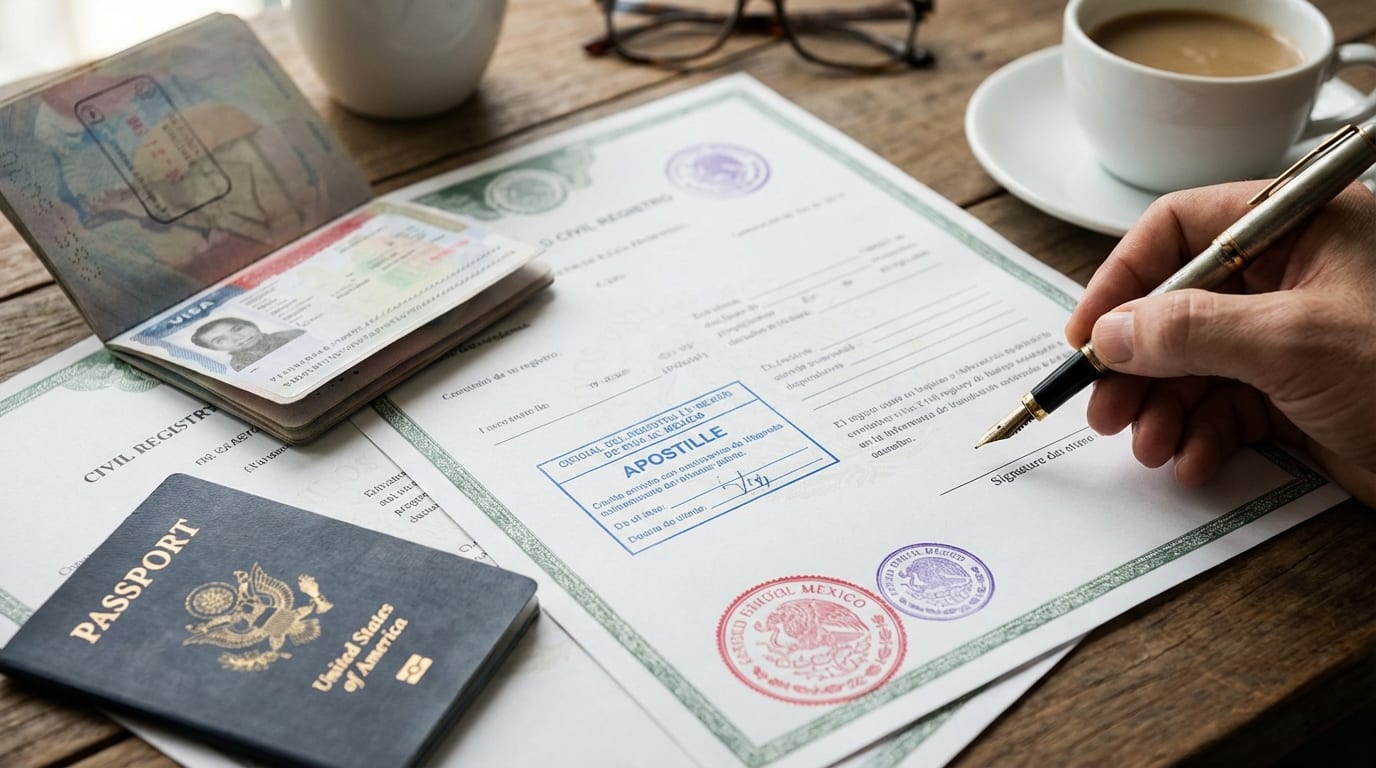
An apostille is a standardized certificate that authenticates the origin of a public document for use in another country. It was established by the 1961 Hague Apostille Convention, and over 129 countries accept apostilled documents. [Source: Aisle]
If your destination country is a Hague Convention member, your U.S. documents (birth certificates, court orders, affidavits) will need an apostille stamp from the Secretary of State in the state that issued the document. If the destination is not a Hague member, you may need a more complex “authentication” or “legalization” process through the U.S. Department of State and the destination’s embassy.
How to Get Documents Translated and Certified
Many countries require all foreign documents to be translated into the local language by a certified or sworn translator. “Certified” means the translator provides a signed statement attesting to the accuracy of the translation. Some countries require the translation itself to be apostilled or notarized as well.
Your destination’s embassy can usually provide a list of approved translators, or your wedding planner may have local contacts who handle this regularly. Budget $50 to $150 per document for professional certified translation.
Timeline: How Long Does Document Preparation Take?
This is where most couples underestimate the process. Here’s a realistic timeline:
| Task | Typical Timeframe |
|---|---|
| Ordering certified birth certificates | 2 to 6 weeks |
| Obtaining a Certificate of No Impediment (CNI) | Approximately 1 month |
| Apostille processing (state Secretary of State) | 8 to 12 weeks |
| Certified translations | 1 to 2 weeks |
| Expedited apostille (third-party service) | 2 to 4 weeks |
| Total estimated lead time | 3 to 6 months |
Mexico, one of the most popular destinations for U.S. couples, has no residency requirement in most states but a suggested planning lead time of 6 to 9 months to account for document preparation. [Source: Aisle] Puerto Rico, as a U.S. territory, uses a simpler domestic process with a suggested lead time of 3 to 4 months. [Source: Rosevow]
Step 4: How Do Residency and Waiting Periods Work?
Arrive in your destination early enough to satisfy residency requirements, which typically range from zero to 14 days, submit documents to the civil registry, and wait through any mandatory waiting periods before your ceremony date.
Residency requirements and waiting periods are two separate things, and confusing them is a common mistake. A residency requirement means you must physically be in the country for a set number of days before you can apply for a marriage license. A waiting period is the gap between submitting your application and being allowed to marry.
The variation across destinations is dramatic. [Source: Destinationido]
| Destination | Residency / Waiting Rule | Notes |
|---|---|---|
| Barbados | No residency, no waiting period | Couples can often marry the same day the license is issued once documents are approved |
| Turks and Caicos | 72 hours (3 full business days) | Must be present for at least 72 hours before the wedding |
| Fiji | 21 days (waivable) | Can be waived for tourists applying for a special marriage license |
| Georgia (country) | No mandatory waiting period | Marriage license valid for 30 days; ceremony must occur within that window |
| France | Lengthy local residence required | One of the most time-intensive destinations for legal weddings |
| Hawaii | No residency requirement | Uses a U.S. state marriage-license system with roughly one-week timing |
The practical takeaway: do not choose the destination first and check the law later. One planning guide explicitly notes that residency rules can be long enough to affect your entire trip itinerary and should be researched before finalizing the location. [Source: Destinationido]
Step 5: What Happens During the Civil Ceremony?
Attend your civil ceremony at the registry office or authorized venue with required witnesses, sign the marriage register, and receive your official marriage certificate or extract.
What Happens During a Civil Ceremony Abroad?
The civil ceremony is typically brief, lasting 15 to 30 minutes. An authorized local officiant or civil official conducts the ceremony, which is a legal requirement in most destinations. [Source: Rosevow] You’ll present your approved documents, exchange declarations of intent (sometimes in the local language, with a translator present), sign the marriage register, and your witnesses will co-sign.
Most countries require two witnesses who are of legal age. Some destinations have specific rules about witness eligibility, so confirm whether your witnesses need to be local residents or can be your own guests.
Can You Combine Civil and Symbolic Ceremonies?
In many destinations, yes. Mexico, Jamaica, and Costa Rica all allow the civil ceremony to take place at your resort or venue, meaning you can weave the legal signing into your larger celebration. In other countries, the civil ceremony must happen at a government office, and you’d hold your symbolic or religious ceremony separately at your chosen venue.
Your wedding planner is the best resource for understanding what’s possible at your specific location. Our destination guides at beachbride.com include country-specific legal requirement summaries and vetted wedding planners who can assist with local paperwork and civil ceremony coordination.
Step 6: How Do You Register Your Marriage in the United States?
Your foreign marriage certificate is generally recognized in the U.S. under principles of comity. No separate registration is required, but you may need certified translations for name changes, immigration, or legal proceedings.
This is the question that causes the most anxiety, and the answer is more reassuring than most couples expect. The United States generally recognizes marriages that were legally performed in foreign countries, provided the marriage was valid under the laws of the jurisdiction where it took place. [Source: Bride-advisor]
Do You Need to Register with the U.S. Embassy?
No. The U.S. embassy abroad does not perform marriages or register foreign marriages. There is no federal marriage registry in the United States. Your foreign marriage certificate is your proof of marriage.
That said, it’s wise to request multiple certified copies of your foreign marriage certificate before leaving the destination. You’ll want at least three to five copies for various administrative purposes back home.
How to Use Your Foreign Marriage Certificate in the U.S.
For practical purposes like changing your name on a Social Security card, updating your driver’s license, or filing joint tax returns, you’ll typically need to present your foreign marriage certificate along with a certified English translation (if the original is in another language). Some agencies may also request an apostille on the certificate itself. Check with each specific agency for their requirements, as they can vary.
What Are the Easiest Countries for Destination Wedding Legalities?
Mexico, Jamaica, Barbados, and Costa Rica have streamlined processes with minimal residency requirements, English-speaking officials (or established bilingual support), and well-developed wedding tourism infrastructure.
Planning guides consistently highlight a few destinations as standouts for legal simplicity. Turks and Caicos, Hawaii, and Portugal rank among the easiest mainstream legal options. [Source: Aisle] Georgia (the country, not the state) and Denmark are also frequently cited for European weddings, with Georgia offering processing times as short as 24 hours.
What makes a destination legally “easy” comes down to a few factors: no residency requirement, short or nonexistent waiting periods, minimal documentation beyond passports and birth certificates, and no translation or apostille burden. Countries that actively market to wedding tourists tend to have simplified their processes accordingly.
For U.S. couples specifically, Cancun and the Riviera Maya remain among the most popular choices because Mexico requires no residency period in most states and has a well-established system for processing foreign couples’ marriages.
What Are the Most Complicated Countries for Legal Destination Weddings?
France, Italy, Bali, and the Maldives require extensive documentation, residency periods, multiple government appointments, and complex bureaucratic processes that make legal ceremonies impractical for most visiting couples.
France is the most frequently cited example. It requires a lengthy local residence period and a civil ceremony at the local mairie (town hall), with paperwork that can take months to process. [Source: Destinationido] Italy has similar complexity, with requirements that vary by comune (municipality) and often include a Nulla Osta (declaration of intent to marry) from the U.S. embassy, followed by publication of banns.
For these destinations, the symbolic ceremony route is often the most practical choice. You can still have your celebration on the Amalfi Coast or in a Provençal vineyard. You’d simply handle the legal marriage at your local courthouse before or after the trip.
What Common Mistakes Should You Avoid?
Starting document collection too late, assuming resort coordinators handle all legal requirements, failing to verify witness eligibility, and not budgeting for translation and legalization costs are the most frequent pitfalls.
-
Starting too late. Apostilles take 8 to 12 weeks, and that’s before translations and other processing. Leaving legal research until after deposits are paid can force you to switch to a symbolic ceremony. [Source: Flawlessweddingsandeventsvi]
-
Assuming the resort handles everything. Many resort wedding coordinators manage logistics like flowers, catering, and photography. They may assist with legal paperwork, but the responsibility for obtaining and authenticating your documents falls on you.
-
Ignoring witness rules. Some countries require witnesses to be unrelated to the couple, to be local residents, or to present identification. Verify this well in advance so you’re not scrambling on the day.
-
Underbudgeting for legal costs. Between apostilles, certified translations, document shipping, and local government fees, legal costs typically add $500 to $1,500 to your wedding budget. This is separate from your ceremony and reception costs.
-
Not re-checking requirements before travel. Legal requirements change. Rules that applied when you started planning may have shifted by the time you travel. Verify current rules with official sources 6 to 8 months before your wedding date, and again 4 to 6 weeks before departure.
Please note: legal requirements for getting married abroad change frequently. All costs and timelines mentioned in this guide are approximate and vary by destination, document type, and processing speed. Always verify current rules directly with official government sources.
Frequently Asked Questions
These are the questions couples ask most often when figuring out how destination weddings work legally, from U.S. recognition to same-sex marriage and costs.
Is a destination wedding marriage legally valid in the United States?
Yes, in most cases. The U.S. generally recognizes marriages performed abroad as long as the marriage was legal under the laws of the country where it took place. You don’t need to re-marry or register separately when you return home. [Source: Bride-advisor]
Do we have to get legally married at the destination?
No. About 70% of couples who marry abroad opt for a symbolic ceremony at the destination and handle the legal marriage separately, often at a courthouse back home. [Source: Aisle] Both approaches are completely valid.
Are same-sex destination weddings recognized in the U.S.?
If your same-sex marriage is legally performed in a country where it’s recognized, the U.S. will generally recognize it as well, following the 2015 Obergefell v. Hodges Supreme Court ruling. However, not all destination countries permit same-sex marriage. Research your specific destination’s laws carefully, as some popular wedding destinations do not legally recognize same-sex unions.
How much do the legal costs add to a destination wedding budget?
Expect to spend $500 to $1,500 on legal-related expenses, including apostilles, certified translations, document shipping, and local government filing fees. This does not include the cost of your ceremony, venue, or planner. Costs vary by destination and the number of documents requiring authentication.
How far in advance should we start the legal process?
Six months is a comfortable starting point for most destinations. Mexico, for example, has a suggested lead time of 6 to 9 months. [Source: Aisle] Simpler destinations like Puerto Rico may need only 3 to 4 months. The more complex the destination’s requirements, the earlier you should begin.
Do we need a lawyer to get legally married abroad?
Not usually, but it depends on the destination. Countries with straightforward processes (Mexico, Jamaica, Barbados) rarely require legal counsel. For more complex destinations like Italy or France, some couples hire a local legal facilitator to navigate the bureaucracy. An experienced local wedding planner can often guide you through the process without a separate attorney.
What if our documents expire before the wedding date?
Some documents have validity windows. A Certificate of No Impediment, for example, is typically valid for six months from its issue date. If your wedding date shifts, you may need to re-obtain certain documents. Build flexibility into your timeline and confirm validity periods for each required document with the destination’s civil registry.
Can our resort wedding coordinator handle all the legal paperwork?
Most resort coordinators assist with the process, but they cannot obtain your personal documents (birth certificates, apostilles, affidavits) on your behalf. They can typically help with local filings, scheduling civil ceremony appointments, and connecting you with translators. The responsibility for gathering and authenticating your U.S. documents remains yours.
Ready to plan the rest of your destination wedding? Explore our venue guides and vendor directories to find the perfect location and team for your celebration.