Is a Destination Wedding Ceremony Automatically Legal?
No. A destination wedding ceremony is only legally binding if you obtain a valid marriage license in that country and meet all local requirements, which vary significantly by jurisdiction.
Here’s a number that surprises most couples: approximately 80% of destination weddings are symbolic, meaning the couple isn’t legally married when they walk back down the aisle. [Source: Romance Travel Group] That’s not a fluke. It’s the direct result of complex, country-specific legal requirements that many couples either don’t know about or can’t complete in time.
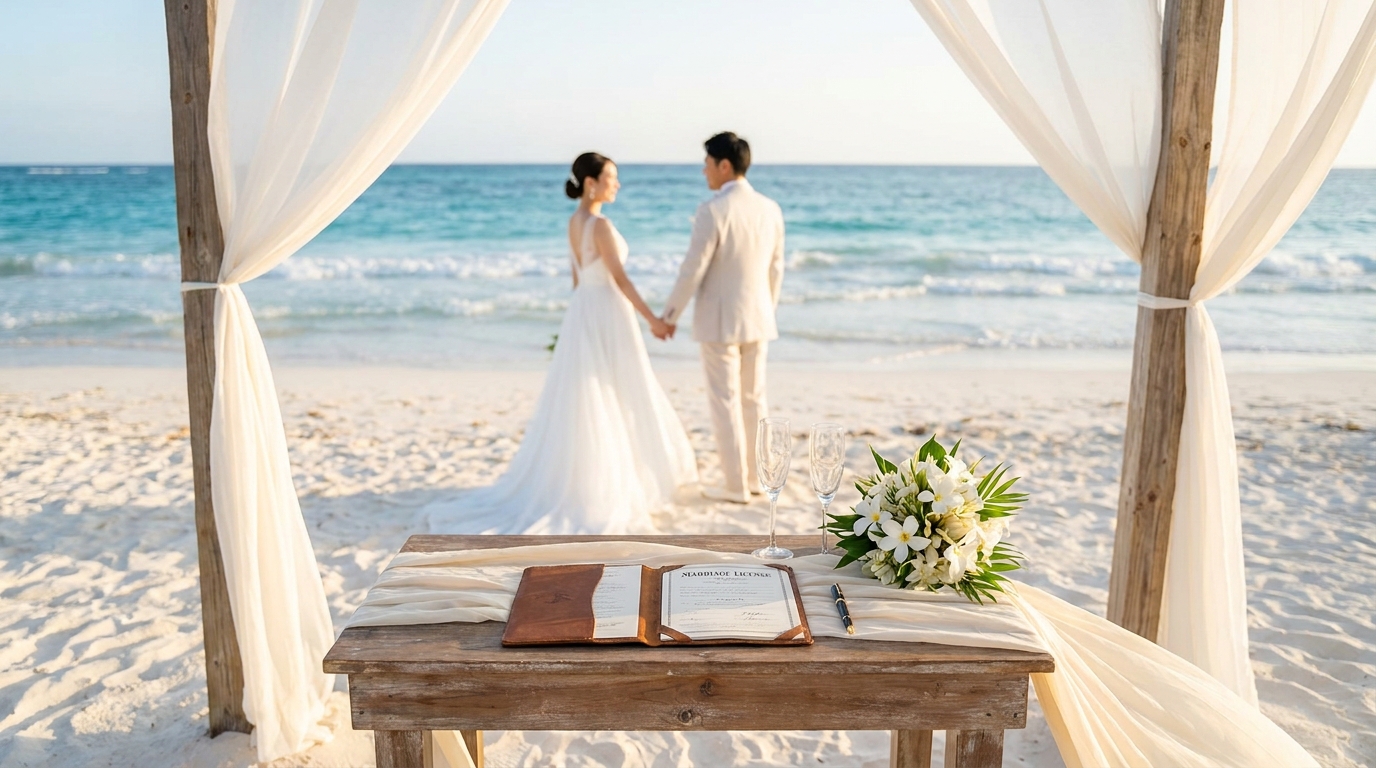
Your destination wedding marriage license doesn’t transfer from home. You can’t apply in New York and use it in Tulum. The license must come from the jurisdiction where the ceremony takes place. For a domestic wedding, that’s your county clerk’s office. For a wedding abroad, it’s the destination country’s civil registry or equivalent government body. Miss that step, and your beautiful beachside vows have the same legal weight as a rehearsal.
The confusion often starts with resort marketing. Packages labeled “wedding packages” frequently include décor, a cake, a photographer, and a coordinator who walks you through a ceremony. What they don’t always include is the legal paperwork. That distinction, between a ceremony that feels like a wedding and one that is a wedding, matters more than most couples realize until it’s too late.
Legal disclaimer: Marriage laws change frequently. Verify current requirements with official government sources before making plans. This article is educational content, not legal advice.
What Makes a Marriage Legal Versus Symbolic?
A legal marriage requires a government-issued license, an authorized officiant, witnesses if required, and proper registration with civil authorities. Symbolic ceremonies have none of these legal components.
The three components every legal marriage needs
Regardless of country, three elements must be present for a marriage to hold up legally:
-
A valid marriage license issued by the local government where the ceremony occurs
-
An officiant authorized by that government to solemnize marriages
-
Compliance with local procedural rules, including witnesses, waiting periods, and document filing deadlines
Remove any one of these, and the ceremony is symbolic by default. [Source: Destify]
Why resort “wedding packages” often include only symbolic ceremonies
Resorts sell experiences, not legal services. A symbolic ceremony is dramatically easier for them to coordinate: no government appointments, no document verification, no liability if paperwork falls through. When a resort coordinator says “we handle everything,” they typically mean everything ceremonial. The flowers, the music, the officiant who reads your vows. They rarely mean the civil registry appointment, the apostilled birth certificate, or the blood test your destination requires.
About 70% of couples who marry abroad choose the symbolic-at-destination route because it’s simpler and cheaper. [Source: Wedding Abroad Group] That’s a perfectly valid choice, as long as you know you’re making it.
How to verify your ceremony will be legally recognized at home
Ask your resort or planner one direct question: “Will this ceremony produce a government-issued marriage certificate that I can register in my home country?” If the answer involves hedging, qualifiers, or a suggestion to “handle the legal part at home,” you’re booking a symbolic ceremony. The U.S. State Department confirms that a marriage performed abroad is generally valid in the United States if it was performed in accordance with the laws of the country where it took place. [Source: U.S. State Department]
Which Countries Make Destination Wedding Marriage Licenses Easiest to Obtain?
Georgia, Denmark, Gibraltar, and Cyprus are the most commonly cited easy destinations, with Jamaica and the Bahamas leading in the Caribbean for minimal paperwork and short waiting periods.
| Destination | Processing Time | Residency Requirement | Complexity |
|---|---|---|---|
| Georgia (country) | Less than 1 day | None | Easy |
| Denmark | ~2 weeks processing | Arrive 2 days before | Easy |
| Gibraltar | 1–2 days | None | Easy |
| Cyprus | 2–3 days | None | Easy |
| Jamaica | 24 hours | 24 hours in-country | Easy |
| Bahamas | Same day | 24–48 hours in-country | Easy |
| Costa Rica | Several days | None | Medium |
| Italy | Weeks to months | None, but extensive paperwork | Complex |
| France | 40+ days | 40-day residency | Very Complex |
| Mexico | 4+ business days | None, but blood tests required | Medium-Complex |
Caribbean destinations with same-day or next-day licenses
Jamaica remains the gold standard for simplicity. You need passports, proof of citizenship, and a 24-hour waiting period after arrival. No blood tests, no residency requirement, no advance document submission. The Bahamas offers same-day issuance after one day in-country, though some guides note you may need two full business days depending on when you arrive. [Source: OneFabDay]
European countries that require advance paperwork but allow legal ceremonies
Denmark and Cyprus stand out. Denmark requires about two weeks of processing but has no residency or waiting period at the destination itself. Cyprus can issue a special license in about three days. Both are dramatically simpler than France or Italy, where the bureaucratic requirements can stretch across months.
Locations where legal marriage is prohibitively complex for tourists
France requires a 40-day residency period before you can legally marry. Italy demands a Nulla Osta (certificate of no impediment), which requires your birth certificate apostilled by your state, then authenticated by the Italian consulate, a process taking 8 to 12 weeks. For most couples, these destinations make far more sense as symbolic ceremony locations with the legal marriage handled at home.
What Documents Do You Actually Need for a Destination Wedding Marriage License?
At minimum, you’ll need valid passports, birth certificates, and proof of divorce or death certificate if previously married. Many countries also require notarized affidavits, apostilles, or certified translations.
Universal documents required in nearly every country
-
Valid passports (not expiring within 6 months of your wedding date)
-
Certified birth certificates
-
Proof of single status or affidavit of eligibility to marry
-
Divorce decree or death certificate of former spouse, if applicable
Country-specific requirements that catch couples off guard
Mexico requires blood tests taken within the country. The Bahamas charges a marriage license and administrative fee of approximately $310. [Source: Zola] Thailand requires a trip to Bangkok for embassy legalization steps, even if your wedding is on a southern island. These aren’t obscure edge cases. They’re standard requirements that surface only when you dig past the resort brochure.
How to get documents apostilled and why it matters
An apostille is a government certification that authenticates a document for use in another country. If your destination requires apostilled documents, you’ll need to send your birth certificate, divorce decree, or other paperwork to your state’s Secretary of State office (in the U.S.) or equivalent authority. Processing times vary from a few days to several weeks. Some states offer expedited service for an additional fee, typically $20 to $75.
Translation and notarization: when you need them and what they cost
Countries where the official language differs from yours will almost always require certified translations. Italy, Mexico, France, and Costa Rica all require documents translated by a certified or sworn translator. Expect to pay $30 to $100 per page for certified translation, and $10 to $25 per document for notarization. These costs add up quickly when you’re translating birth certificates, divorce decrees, and affidavits.
How Far in Advance Should You Start the Marriage License Process?
Start 3 to 6 months before your wedding date. Some countries require documents submitted 8 to 12 weeks in advance, and obtaining apostilles or translations can take 4 to 8 weeks on their own.
Timeline for countries with advance submission requirements
One destination wedding legal guide recommends starting paperwork a full 6 months before your wedding date and planning 12 to 18 months ahead overall to accommodate translations, government appointments, and residency requirements. [Source: Bride Advisor] Here’s a practical timeline:
-
6+ months out: Order certified copies of birth certificates, obtain divorce decrees, schedule embassy or consulate appointments, and arrange translations and apostilles
-
3 to 4 months out: Submit advance paperwork to the destination country’s civil registry if required
-
2 to 4 weeks out: Apply for the local marriage license, if the jurisdiction allows or requires it within a specific window
-
Arrival: Allow extra days on-site if there’s a residency or waiting period before the ceremony
What happens if you miss document deadlines
You won’t be legally married at your destination. There’s no workaround, no expedited exception at the civil registry. If Italy’s consulate hasn’t authenticated your Nulla Osta, the ceremony proceeds as symbolic only. If Mexico’s blood test results aren’t ready, same outcome. Your planner may offer to convert to a symbolic ceremony, but that’s a consolation, not a solution.
Rush processing options and their costs
Some apostille offices offer same-day or next-day processing for $50 to $150 above standard fees. Private document expediting services charge $100 to $400 to handle the entire apostille and translation process. Whether these are worth it depends on how close you are to your deadline, but they exist as a safety net if you started late.
Should You Get Legally Married at Home or at Your Destination?
Get legally married at home if your destination requires residency periods, extensive paperwork, or blood tests. Get married at your destination if the process is simple and you want one ceremony.
When the “legal at home, symbolic abroad” approach makes sense
Most couples prefer to legally get married in their home country before having a symbolic wedding at a destination because it saves time, reduces stress, and avoids complications. [Source: Rustic Pathways] This approach is especially practical for France (40-day residency), Italy (months of apostille processing), and Indonesia (religious ceremony requirements). You handle the legal filing at your local courthouse, then celebrate abroad without worrying about paperwork.
The emotional trade-off: two ceremonies versus bureaucratic hassle
Some couples feel strongly that the moment they say their vows should be the moment they’re legally married. That’s a valid preference, and destinations like Jamaica, the Bahamas, and Hawaii make it entirely achievable. But if your heart is set on Santorini or Tulum, the legal complexity may mean choosing between the emotional ideal and the practical reality.
How to make a courthouse ceremony feel special before you travel
A courthouse ceremony doesn’t have to feel like a bureaucratic errand. Wear something you love, bring your closest friend or family member as a witness, and take photos. Some couples treat it as a private, intimate moment that belongs just to them, separate from the larger celebration abroad. The legal date becomes your “official” anniversary, and the destination ceremony becomes the celebration you share with everyone.
Tax and insurance implications of your legal marriage date
Your legal marriage date affects tax filing status, health insurance enrollment windows, and beneficiary designations. If you marry at the courthouse in October but hold your destination ceremony in December, October is your legal anniversary for tax purposes. Consult a tax professional about the implications, especially if marrying late in the calendar year.
What Are the Marriage License Requirements for Popular Destination Wedding Locations?
Requirements range from Jamaica’s simple 24-hour wait with just passports to France’s 40-day residency requirement and Italy’s complex apostille process requiring months of advance preparation.
Mexico (Cancun, Tulum, Cabo): what the 4-day requirement really means
Mexico requires blood tests taken within the country, a 4-business-day processing period for the marriage license, and documents translated into Spanish by a certified translator. Total legal process costs run approximately $500 to $1,500 including blood tests, translations, and local legalization. [Source: Wedding Abroad Group] The “4-day requirement” refers to business days, so plan to arrive at least a week before your ceremony if you’re pursuing a legal wedding. Our step-by-step guide to getting legally married in Mexico covers the full process, and our Cancun wedding planning guide handles the destination-specific logistics.
Jamaica: the easiest Caribbean option
Jamaica consistently ranks as the simplest destination for a legal wedding. Requirements: valid passports, certified birth certificates, proof of divorce if applicable, and a 24-hour waiting period after arrival. Legal process costs run $200 to $500. [Source: Wedding Abroad Group] No blood tests, no residency requirement, no advance document submission.
Hawaii: US citizens versus international couples
For U.S. citizens, Hawaii is the simplest option of all because it’s domestic. No apostilles, no translations, no foreign government bureaucracy. You apply for a Hawaii marriage license online, and there’s no waiting period or residency requirement. International couples face additional documentation requirements but still benefit from Hawaii’s straightforward process compared to most foreign destinations.
Italy and France: why most couples choose symbolic ceremonies
Italy’s legal process costs €300 to €800 (about $340 to $910) excluding translations, and the Nulla Osta authentication process through the Italian consulate takes 8 to 12 weeks. France requires 40 days of residency and legal costs of €500 to €1,500 (about $570 to $1,700). [Source: Wedding Abroad Group] These timelines and costs explain why the vast majority of couples in these destinations opt for symbolic ceremonies.
Bali and Thailand: religious versus civil ceremonies
Indonesia requires a religious ceremony component, and the legal process costs €500 to €1,500 (about $570 to $1,700). Thailand’s legal process runs €200 to €500 (about $230 to $570), but requires a trip to Bangkok for embassy legalization, even if your ceremony is in Koh Samui or Phuket. Both destinations add layers of complexity that make the “legal at home” approach attractive.
Costa Rica: the “good enough” middle ground
Costa Rica doesn’t require residency, blood tests, or advance document submission. You’ll need apostilled birth certificates and a local attorney to process the marriage, but the overall process is more manageable than Mexico or Italy. It’s a solid middle-ground option for couples who want a legal ceremony abroad without extreme bureaucratic hurdles.
How Much Does It Cost to Get a Marriage License Abroad?
License fees range from $50 to $200, but total costs including document preparation, apostilles, translations, and legal assistance typically run $300 to $1,200 depending on country complexity.
Note: All costs are estimates based on 2024-2025 data. Prices vary by location and service provider.
Government fees versus “wedding coordinator” fees
The government license fee itself is often the smallest line item. Some Caribbean destinations charge around $50 to $120 for the license with 24 to 48 hours of processing. [Source: Bride Advisor] U.S. states typically charge $25 to $120 depending on the county. [Source: David’s Bridal] The real expense comes from everything around the license: translations, apostilles, local attorney fees, and courier services.
Hidden costs: apostilles, translations, and courier services
Apostille fees range from $5 to $50 per document at the state level, but expedited processing and private services can push that to $100 to $400. Certified translations cost $30 to $100 per page. International courier services for sending original documents run $50 to $150 round-trip. A couple marrying in Italy might spend $600 to $1,000 on document preparation alone before touching the actual license fee.
When hiring a local attorney is worth the expense
In countries like Costa Rica and Mexico, a local attorney is either required or strongly recommended to navigate the civil registry process. Attorney fees for marriage legalization typically run $200 to $500. Working with a planner who has handled dozens of legal marriages in your destination means they know which civil registry office moves fastest, which documents the local officials actually scrutinize, and how to fix paperwork issues before you board your flight. Our vendor directory connects you with planners who specialize in navigating legal paperwork in specific countries.
Will Your Destination Wedding Marriage Be Recognized in Your Home Country?
Yes, if performed legally in the destination country. Most nations recognize foreign marriages through international treaties, but you may need to register it with your home government afterward.
How to register your foreign marriage in the US, UK, Canada, and Australia
The U.S. State Department confirms that a marriage performed abroad is generally recognized in the United States if it was legal where it took place. [Source: U.S. State Department] However, you may need to check with your state’s Attorney General for specific documentation requirements. In the UK, you’ll typically need to obtain an apostilled copy of your foreign marriage certificate. Canada and Australia have similar recognition frameworks but may require registration with provincial or state authorities.
Countries that don’t recognize certain foreign marriages
Some countries have restrictions on recognizing marriages performed under specific religious or civil frameworks. If either spouse holds dual citizenship, the laws of both countries may apply. Always verify recognition requirements with your home country’s embassy or consulate before the wedding.
Same-sex marriage: where it’s legal for destination weddings
Same-sex marriage is legally recognized in many popular destination wedding locations, including the U.S. (all states, including Hawaii), most of Western Europe, Costa Rica, and parts of Mexico. It is not legal in Jamaica, Bali (Indonesia), or Thailand. If you’re a same-sex couple planning a legal destination wedding, confirming legality in your chosen destination is the first step, not an afterthought.
What Happens If You Skip the Legal Paperwork and Just Have a Ceremony?
You’re not legally married. This affects taxes, insurance, inheritance rights, and spousal benefits. You’ll need to complete legal paperwork at home to be recognized as married.
Legal and financial consequences of symbolic-only ceremonies
Without a valid marriage license, your marriage is deemed not legally recognized. [Source: Zola] That means no joint tax filing, no automatic inheritance rights, no spousal health insurance coverage, and no legal authority to make medical decisions for each other. These aren’t abstract concerns. They’re practical realities that affect your daily life as a couple.
How to handle the legal paperwork after returning home
If you had a symbolic ceremony abroad, you can complete the legal marriage at home by applying for a marriage license in your local jurisdiction, having a brief civil ceremony (even at the county clerk’s office), and filing the signed license. The process typically takes a few days to a few weeks depending on your state or country’s requirements.
What to tell guests about your ceremony’s legal status
You don’t owe anyone an explanation, but transparency avoids confusion. Many couples simply note on their wedding website that they’ll be completing legal paperwork separately. Some frame it as “we’re making it official at the courthouse, then celebrating with you in paradise.” Guests care about the celebration, not the filing status.
Who Can Legally Officiate a Destination Wedding?
Only officiants authorized by the destination country’s government can perform legal marriages. Resort coordinators, ship captains, and online-ordained ministers typically cannot unless specifically licensed locally.
Why your friend can’t legally marry you abroad (even if ordained online)
Online ordination through Universal Life Church or similar organizations is recognized in many U.S. states, but it carries zero legal weight in most foreign countries. Italy, Mexico, Jamaica, France, and Costa Rica all require officiants authorized by their own government. Your college roommate’s internet ordination certificate won’t pass muster at a Mexican civil registry.
How to verify an officiant’s legal authority
Ask your planner or the local civil registry for the officiant’s registration number or authorization documentation. In many countries, only a civil judge, mayor, or designated government official can perform a legal ceremony. Religious officiants may also have authority, but only if registered with the local government.
Civil ceremonies versus religious ceremonies: legal differences by country
In some countries (Costa Rica, parts of Mexico), religious ceremonies can be legally binding if the officiant is registered with the government. In others (France, Germany), only a civil ceremony performed by a government official creates a legal marriage. Religious ceremonies in these countries are always supplementary, never sufficient on their own.
What Questions Should You Ask Your Wedding Planner About Legal Requirements?
Ask: “Will this ceremony be legally binding?”, “What documents do we submit and when?”, “Who is the licensed officiant?”, and “What’s your backup plan if paperwork is rejected?”
Beyond those four essentials, dig into specifics:
-
“What are the government fees for the license, and what are your service fees?” Some Caribbean destinations charge $50 to $120 for the license itself. [Source: Bride Advisor] Your planner’s coordination fee should be itemized separately.
-
“Have you handled legal marriages for couples from my country before?” Experience with your specific home-country requirements matters.
-
“What’s the latest date I can submit documents without risking delays?” Get a hard deadline, not a vague “a few weeks before.”
-
“Do you work with a local attorney, and is that cost included?” In countries where legal counsel is required, this should be part of the package.
-
“What happens if the civil registry rejects our paperwork on-site?” A good planner has a contingency plan. A great one has prevented the problem before it starts.
Working with a planner who has handled dozens of legal marriages in your specific destination means they know which documents local officials actually scrutinize, which civil registry office processes applications fastest, and how to resolve issues before you board your flight.
Ready to plan the legal side of your destination wedding? Download our country-by-country marriage license checklist to see exactly what documents you need, when to submit them, and whether getting married at home first makes more sense for your situation.
Frequently Asked Questions
Below are the most common questions couples ask when sorting out the legal side of a destination wedding.
Can we use a marriage license from our home state for a destination wedding abroad?
No. A marriage license is valid only in the jurisdiction that issued it. If you’re marrying in Jamaica, you need a Jamaican marriage license. If you’re marrying in Italy, you need to go through Italy’s civil process. Your home-state license cannot be transferred internationally.
How long does it take to get a marriage license in the Caribbean?
It depends on the island. Jamaica requires a 24-hour waiting period after arrival. The Bahamas requires 24 to 48 hours of residency before applying, with same-day issuance after that. St. Lucia requires two days before applying plus two more days for processing. [Source: OneFabDay]
Do we need blood tests for a destination wedding?
Some countries require them. Mexico is the most notable example among popular wedding destinations, requiring blood tests taken within the country as part of the marriage license process. Most Caribbean islands, European countries, and Costa Rica do not require blood tests.
What is an apostille, and do we need one?
An apostille is an international certification that authenticates a document (like a birth certificate or divorce decree) for use in another country. Countries that are members of the Hague Apostille Convention accept apostilled documents. If your destination requires one, you’ll obtain it from your state’s Secretary of State office in the U.S. or the equivalent authority in your country.
Is a symbolic destination wedding ceremony worth having?
Absolutely. Approximately 80% of destination weddings are symbolic. [Source: Romance Travel Group] A symbolic ceremony lets you celebrate with your guests in a beautiful setting without the stress of foreign legal paperwork. You simply handle the legal marriage at home before or after your trip.
How much does a destination wedding cost compared to a local wedding?
The average destination wedding costs about $28,000, compared with approximately $35,000 for a domestic wedding in the U.S. [Source: Rustic Pathways] Costs vary significantly by location, guest count, and whether you pursue a legal or symbolic ceremony abroad.
Can same-sex couples legally marry at destination wedding locations?
It depends entirely on the destination. Same-sex marriage is legal in Hawaii, Costa Rica, most of Western Europe, and parts of Mexico. It is not legal in Jamaica, Bali (Indonesia), or Thailand. Always confirm current laws with the destination country’s government or embassy before booking.
What if our destination wedding paperwork is rejected when we arrive?
If your documents are rejected at the civil registry, your ceremony will proceed as symbolic only. You won’t be legally married. This is why starting paperwork 3 to 6 months early and working with an experienced local planner are so important. They can catch issues, like missing apostilles or incorrect translations, before you travel.