Why Do Destination Wedding RSVPs Need Different Deadlines Than Traditional Weddings?
Destination wedding RSVP deadlines need to land 6 to 12 weeks before the event, not the standard 3 to 4 weeks, because guests must book flights, hotels, and time off work before they can commit.
A traditional wedding RSVP works on a simple premise: guests check a box, drop a card in the mail, and show up. Your destination wedding RSVP process can’t operate that way. When attendance requires passports, international flights, multi-night hotel stays, and vacation days, the decision to attend is a financial and logistical commitment that takes weeks or months to sort out.
The numbers reflect this. Destination weddings typically see 60–70% of invited guests RSVP “yes,” compared with roughly 80–85% for local weddings. [Source: Destify] On top of that, about 20–30% of all wedding guests miss the RSVP deadline entirely and need follow-up. [Source: Destify] When you combine slower responses with the earlier vendor deadlines that resorts require (often 60–120 days out), the math demands an earlier start.
The complexity of the destination also matters. A Hawaii wedding where most guests fly domestically might work with a 6 to 8 week RSVP deadline. An international wedding in Bali or Santorini, where guests need visas and long-haul flights, may need 10 to 12 weeks.
When Should You Send Destination Wedding Invitations and Set RSVP Deadlines?
Send formal invitations 6 to 8 months before your wedding and set the RSVP deadline 4 to 5 months out, giving guests enough time to decide while leaving you room to finalize vendor counts.
Save-the-dates vs. formal invitations: what timeline actually works
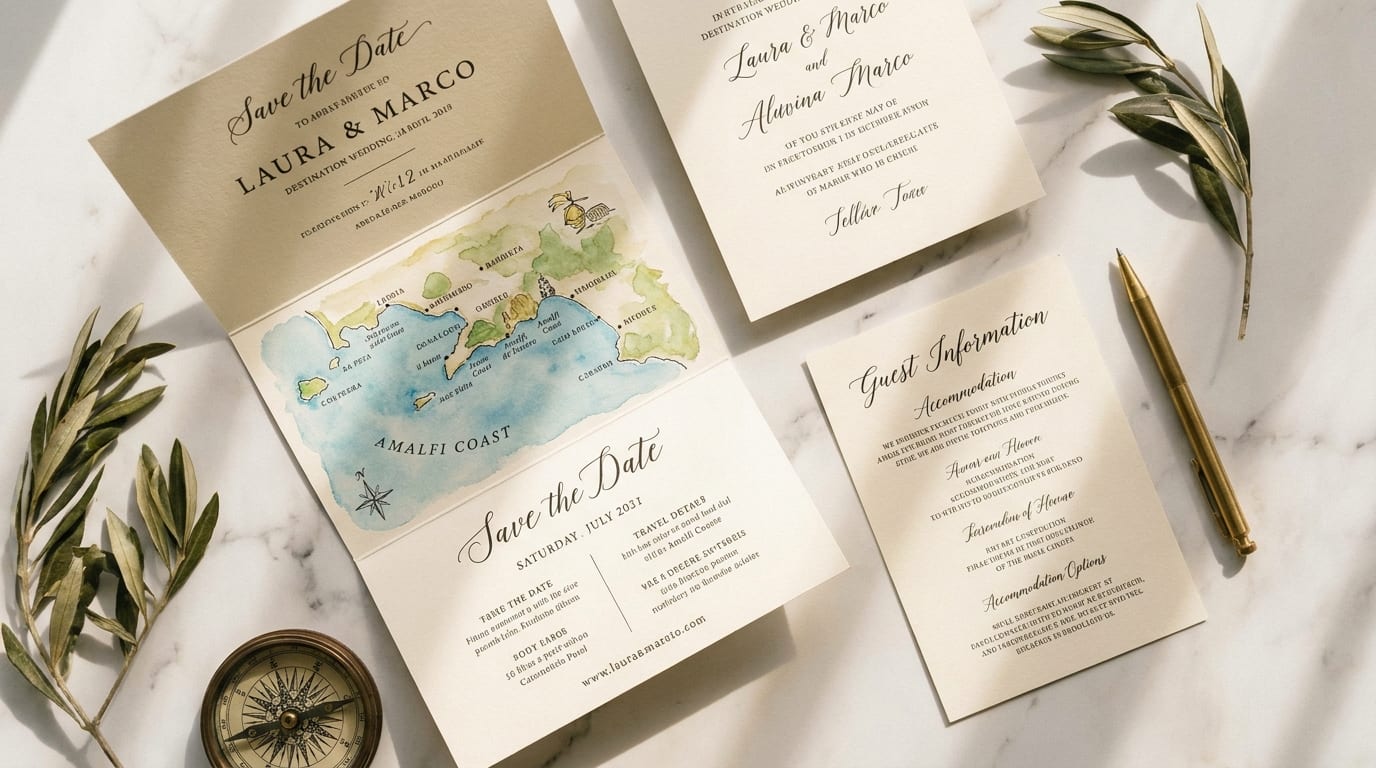
Save-the-dates should go out 8 to 12 months before your wedding. They’re not just a courtesy for destination weddings. They’re a planning tool. Guests use them to start researching flights, requesting time off, and budgeting. Your formal invitation, sent at the 6 to 8 month mark, then converts that early awareness into a concrete yes or no.
Include a brief note on the save-the-date that says something like: “Formal invitation with travel details to follow. We recommend holding off on booking flights until you receive it.” This prevents premature bookings on wrong dates while keeping your wedding on their radar.
Save the Dates from Minted
Photo save the dates, magnets, and postcards designed by independent artists. Order 6+ months out for best price tiers and free recipient addressing.
Free guest address printing on orders 50+.
Browse Save the DatesHow room block cut-off dates affect your RSVP deadline
Your RSVP deadline should fall 2 to 4 weeks before your room block expires. Resort room block deadlines typically land 90 to 180 days before the wedding. [Source: Paperlust] If your block closes on September 1, aim for an RSVP deadline around August 1 to August 15. That gives guests who RSVP “yes” enough time to book at the group rate before rooms are released.
The two-deadline system: initial RSVP vs. final headcount
Here’s where destination wedding guest list management gets practical. Instead of one deadline, use two:
-
Initial RSVP deadline (4–5 months out): Guests confirm whether they plan to attend.
-
Final headcount deadline (6–8 weeks out): You confirm actual attendance based on who has booked travel and accommodations.
This two-phase approach accounts for the gap between “yes, we’d love to come” and “yes, we’ve actually booked flights.” It also gives you a natural reason to follow up with guests who said yes but haven’t taken action.
What Information Should a Destination Wedding RSVP Card Actually Collect?
Collect attendance confirmation, full guest names, dietary restrictions, and whether they’ve booked resort accommodations, but skip flight details and arrival times on the RSVP itself.
Why asking “have you booked your room?” matters more than meal choice
For a destination wedding, the most important data point isn’t chicken or fish. It’s whether your guest has actually committed to travel. Adding a simple checkbox like “Have you reserved your room at [Resort Name]? Yes / Not yet” gives you an instant read on who’s truly coming versus who’s still on the fence. Since destination wedding attendance can drop 5–10% between RSVP “yes” and actual show-up due to travel issues, this question is your early warning system. [Source: Knotuploader]
Digital vs. paper RSVPs: which gets better response rates for destination weddings
Digital RSVPs consistently outperform paper for destination weddings. They eliminate international mail delays, allow you to embed room block links directly alongside the response form, and make it easy to send automated reminders. Industry practitioners typically report that digital RSVPs produce faster response times, partly because the barrier to responding is a few taps rather than finding a stamp and a mailbox.
If you want to learn more about building an effective wedding website, that’s where your digital RSVP system will live.
What not to ask on the RSVP (and where to collect that info instead)
Keep the RSVP card focused. Don’t ask for flight numbers, arrival times, or shuttle preferences. Those details change constantly and clutter your response form. Instead, collect travel logistics through a separate form on your wedding website closer to the event, around 3 to 4 weeks out, when plans are firmer.
How Do You Track RSVPs When Guests Book Rooms Separately From Responding?
Use a shared spreadsheet or wedding website dashboard to track three statuses per guest: RSVP received, room booked, and travel confirmed, updating as you get information from the resort or your travel coordinator.
Free tools that actually work: Google Sheets templates vs. wedding website RSVP managers
A Google Sheet with columns for guest name, RSVP status, room booking status, dietary needs, and notes is genuinely all most couples need. Wedding website platforms like Zola, WithJoy, and The Knot offer built-in RSVP managers that handle the response collection, but they rarely track room bookings automatically. You’ll likely need a hybrid: the website collects RSVPs, and your spreadsheet tracks the full picture.
How to get room booking updates from your resort or travel coordinator
Ask your resort or destination wedding planner for a weekly or biweekly room block report. Most resorts will share a list of names that have booked under your block code. Cross-reference that list against your RSVP tracker. Some resorts and planners offer RSVP management services that handle this coordination for you, which is worth asking about during your initial planning conversations.
Managing the gap between “yes” and “booked”: follow-up timelines that work
The gap between a verbal “yes” and a confirmed booking is where headcounts fall apart. Set a travel checkpoint: ask guests to book by a specific date and send a polite reminder 8 to 12 weeks out, then again 4 to 6 weeks out for anyone who hasn’t booked. [Source: Knotuploader]
What Do You Do When Guests RSVP Yes but Don’t Book Travel?
Send a friendly check-in email 2 to 3 weeks after your RSVP deadline asking if they need help booking, and set a final “book by” date 8 to 10 weeks before the wedding.
The “soft deadline” approach: how to nudge without nagging
Frame your follow-up around helpfulness, not pressure. Something like: “Hey! We noticed you haven’t booked your room yet. Our room block rate expires on [date], and we’d hate for you to miss it. Need help with the booking link?” This positions you as a resource, not a taskmaster.
When to move a non-booker from “yes” to “unlikely” in your headcount
If a guest has RSVP’d yes but hasn’t booked travel, count them as a “soft yes” until booking is confirmed. [Source: Alibaba] After two follow-ups with no booking action, move them to “unlikely” in your planning spreadsheet. You can still welcome them if they book late, but don’t build your catering count around them.
Sample follow-up messages that get responses
Two weeks after RSVP deadline (text): “Hi [Name]! Just checking in. We’re finalizing plans for the wedding and wanted to see if you need the resort booking link or have any questions about travel. No pressure, just want to make sure you don’t miss the group rate!”
Find Your Wedding Venue & Guest Hotels
Compare resort rates, read verified guest reviews, and book with free cancellation. Filter by wedding-friendly properties at your destination.
Free cancellation on most properties. No booking fees.
Search HotelsFour weeks after RSVP deadline (text or call): “Hey [Name], we need to give the resort our final room count by [date]. Are you still planning to join us? Either way is totally fine. Just need to know so we can finalize everything.”
How Do You Handle Non-Responders Without Alienating Guests?
Text or call non-responders one week after the deadline with a casual check-in, then follow up again 10 days later with a firm “need to know by [date]” message.
Destination weddings commonly see 30–40% decline rates, compared with about 15–20% for local weddings. [Source: WithJoy] That means a significant chunk of your guest list will say no, and another chunk will simply not respond. Both are normal.
Why texting works better than email for destination wedding follow-ups
Emails get buried. Texts get read within minutes. For destination wedding follow-ups, a direct text or phone call is more personal and tends to produce faster responses than a mass email. Keep it short, warm, and specific about what you need.
The “we need to give the resort final numbers” script
“Hey [Name], hope you’re doing well! We need to submit our final guest count to the resort by [date]. Could you let us know if you’re able to make it? Totally understand either way. We just need a headcount for the venue.”
The resort deadline is your best friend here. It gives you a legitimate, external reason to ask, which removes the awkwardness of seeming pushy.
When to assume a non-response is a no
After two direct outreach attempts with no reply, count the guest as a decline for planning purposes. Many planners recommend this approach. You can always add them back if they reach out later, but your vendor deposits shouldn’t hinge on silence.
Should You Use a Wedding Website RSVP System or Paper Cards?
Digital RSVPs through your wedding website produce faster response rates and eliminate manual data entry, but include a paper option for older guests who prefer traditional mail.
Greenvelope’s benchmark report found a median RSVP response rate of 88.9% for weddings, with 80.9% of responses being “yes.” [Source: Destify] Digital systems help you get closer to that benchmark by reducing friction. Guests click a link, fill in their details, and you have the data instantly in a dashboard.
Best wedding website platforms for destination wedding RSVP tracking
Zola, WithJoy, and The Knot all offer free RSVP collection tools. For destination weddings specifically, look for platforms that let you add custom questions (like “Have you booked your room?”), send automated reminders, and export guest data to a spreadsheet.
How to make digital RSVPs easy for less tech-savvy guests
Include the direct URL on a printed card inside your invitation. Make the link short and memorable. Add a QR code for smartphone users. And for the handful of guests who truly can’t navigate a website, include a phone number they can call or text to RSVP directly to you.
The hybrid approach: digital default with paper backup
Send your invitations with a digital RSVP as the primary method and include a small printed response card with a stamped return envelope for anyone who prefers paper. This covers all your bases without doubling your workload.
How Do Room Blocks Affect Your RSVP Strategy?
Room block cut-off dates, typically 30 to 45 days before the wedding, force you to collect RSVPs earlier and communicate booking urgency clearly on invitations and your wedding website.
What happens if guests book after the room block expires
Once the block expires, rooms revert to standard pricing and availability. Guests can still book, but they’ll likely pay more and may not get the same room type. Make this clear in your communications so guests understand the deadline isn’t arbitrary.
How to communicate room block deadlines without sounding pushy
Put the room block details, including the rate, booking code, and cutoff date, on your wedding website’s travel page and on a separate accommodations card in your invitation suite. Frame it as a perk: “We’ve reserved a block of rooms at a special rate of $X/night. Book by [date] to secure this rate.”
Wedding Invitations from Minted
Designer wedding invitations from over 16,000 independent artists. Foil-pressed, letterpress, and digital prints with free guest addressing on most orders.
Trusted by 1M+ couples. Free guest address printing.
Browse InvitationsCourtesy blocks vs. guaranteed blocks: which gives you more flexibility
A courtesy block holds rooms without financial commitment from you. Unbooked rooms are released after the cutoff. A guaranteed block requires you to pay for a minimum number of rooms regardless of bookings. For most destination weddings, a courtesy block offers more flexibility since you’re not on the hook if attendance is lower than expected. Wedding room block guidance suggests planning around 30–50% of your total guest count for block sizing. [Source: Paperlust]
What’s a Realistic RSVP Response Rate for Destination Weddings?
Expect 50–70% of invited guests to attend a destination wedding, with the exact rate depending on travel distance, cost, and your relationship with each guest.
Here’s how attendance typically breaks down by guest category:
| Guest Category | Estimated Attendance Rate |
|---|---|
| Immediate family | 85%+ |
| Close friends | 60–70% |
| Extended family | 50–60% |
| Out-of-town guests (flights required) | 55–65% |
| Destination-only guests (international travel) | 35–50% |
| Coworkers / acquaintances | 30–40% |
[Source: Destify]
How to estimate your guest count before RSVPs come in
If you invite 100 guests to a destination wedding, plan for roughly 60 to 70 to attend. [Source: Destify] For budgeting purposes, use 60% as your working number and adjust upward only after RSVPs confirm higher attendance.
Why destination weddings have lower acceptance rates (and why that’s okay)
Lower attendance isn’t a reflection of how much people care about you. It’s a reflection of the financial and logistical reality of travel. Zola data cited by Brides shows overall RSVP “yes” rates rose from 69% in 2019 to 75% in 2022, but destination weddings still consistently land below those averages because of the added travel burden. [Source: Knotuploader] The guests who do come are the ones who are genuinely invested, and that often makes for a more intimate, meaningful celebration.
Using your save-the-date response rate to predict final attendance
Pay attention to informal responses when save-the-dates go out. If 70 out of 100 guests express enthusiasm, you can reasonably expect 50 to 60 to actually attend after accounting for the typical drop-off. This early signal helps you size room blocks and set initial vendor estimates.
How Do You Manage Last-Minute RSVPs and Cancellations?
Set a hard final deadline 6 to 8 weeks before the wedding for vendor counts, and communicate that late RSVPs may not guarantee seating or meal choices due to resort minimums.
The final headcount deadline: when to stop accepting changes
Your final headcount deadline should align with your venue’s last date for guaranteed numbers, typically 2 to 4 weeks before the wedding. After that point, changes may cost you money. Communicate this clearly: “We’re finalizing our guest count with the resort on [date]. After that, we may not be able to accommodate changes.”
How to handle cancellations after you’ve paid deposits
Late cancellations are a reality of destination weddings. Plan for about 5–10% of “yes” RSVPs to drop off before the event due to travel problems or last-minute conflicts. [Source: Destify] Build this buffer into your vendor contracts where possible. Ask your venue and caterer about their policies for reducing headcounts after deposits, and keep some flexibility in your numbers until the latest permitted date.
Travel insurance and guest cancellations: what couples should know
Encourage guests to purchase travel insurance when they book flights and hotels. This protects them financially if they need to cancel, and it reduces the guilt factor that sometimes causes guests to ghost rather than officially cancel. Include a note on your wedding website recommending travel insurance alongside your booking details. Costs vary by provider and coverage level, so suggest guests compare options when booking.
Ready to get organized? Start building your guest list tracking system now. Download our free destination wedding RSVP spreadsheet template and timeline calculator to stay organized from save-the-dates through final headcount.
Frequently Asked Questions
Here are answers to the most common questions couples ask about managing destination wedding RSVPs and guest responses.
How far in advance should I send destination wedding invitations?
Send formal invitations 6 to 8 months before your wedding. Save-the-dates should go out even earlier, around 8 to 12 months in advance, so guests can start planning travel and requesting time off work.
What is a normal RSVP “yes” rate for a destination wedding?
Expect roughly 50–70% of invited guests to say yes, with 60–65% being a practical planning estimate. Local weddings typically see 80–85% acceptance, so the lower rate for destination events is completely normal. [Source: Destify]
Should my RSVP deadline come before or after the room block cutoff?
Before. Set your RSVP deadline 2 to 4 weeks before the room block expires so guests who confirm attendance still have time to book at the group rate.
How do I follow up with guests who haven’t responded?
Send a friendly text or make a phone call one week after the deadline. If there’s no response, follow up again 10 days later with a specific date by which you need an answer. After two attempts, count silence as a decline for planning purposes.
What percentage of “yes” RSVPs actually show up to a destination wedding?
About 90–95% of confirmed guests typically attend, meaning you should expect a 5–10% drop-off between “yes” RSVPs and actual attendance due to travel complications or last-minute conflicts. [Source: Knotuploader]
Are digital RSVPs better than paper for destination weddings?
Yes, for most couples. Digital RSVPs eliminate international mail delays, allow you to embed travel links, and make it easy to send reminders. Include a paper backup option for guests who prefer traditional mail.
How many rooms should I block for my destination wedding?
Plan for about 30–50% of your total invited guest count. Not every invitee will travel, and some who do will book outside the block. Divide your expected out-of-town guests by two and add 3 to 5 rooms for solo travelers or late additions.
When should I stop accepting RSVP changes?
Set a hard final headcount deadline 6 to 8 weeks before the wedding. After that, changes may affect your vendor contracts and costs. Communicate this date clearly on your wedding website and in follow-up messages.