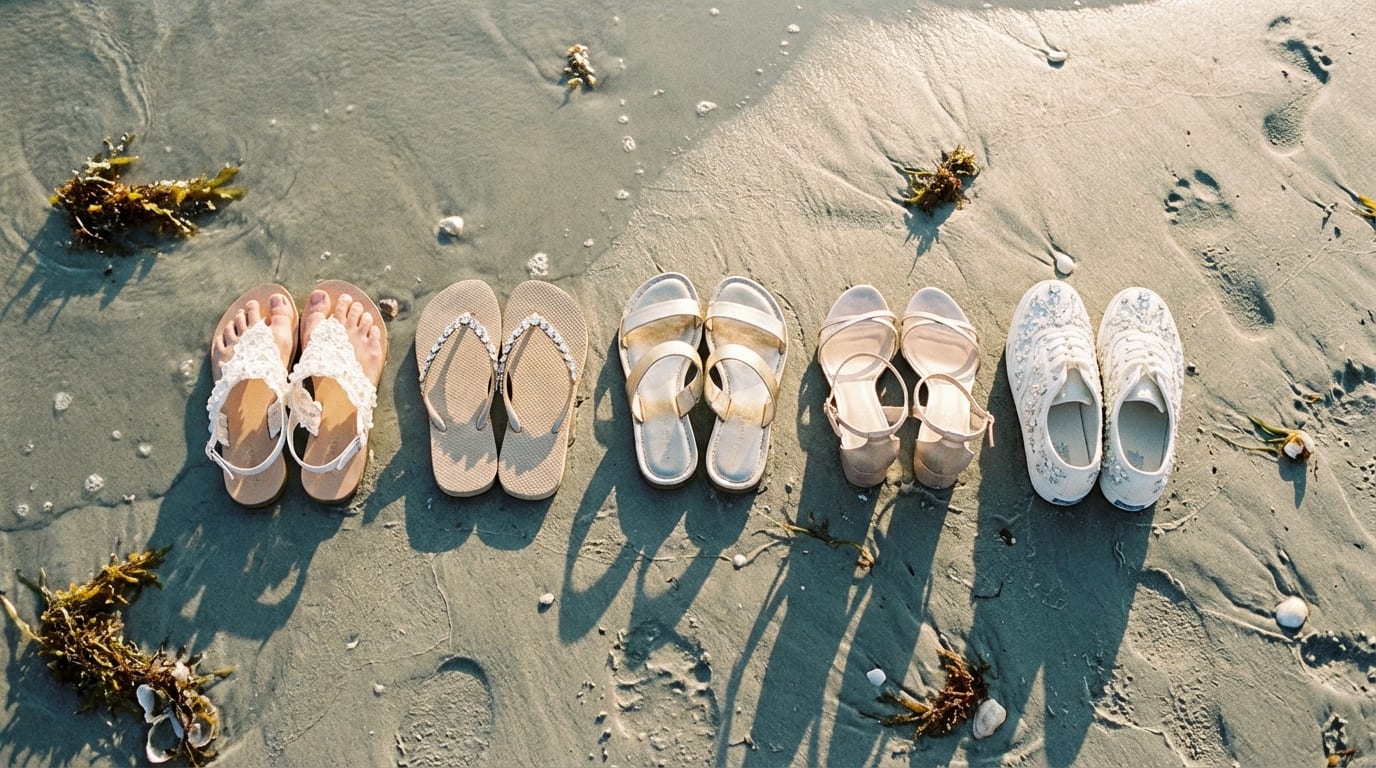
What Makes Wedding Shoes Work on Sand?
Beach wedding shoes need wide bases to prevent sinking, breathable materials for heat, and secure straps since sand destabilizes footing.
Choosing wedding shoes for the beach isn’t the same as picking shoes for an indoor venue. Sand behaves differently than tile, hardwood, or even grass. The physics of walking on a shifting surface changes everything about what works on your feet, and ignoring that reality leads to sinking heels, blistered toes, and ceremony photos you’d rather forget.
The physics problem: why regular heels fail on sand
A narrow heel concentrates your body weight onto a tiny contact point. On a hard floor, that’s fine. On sand, it means your heel punches straight down. A stiletto tip with roughly 0.25 square inches of surface area creates enormous pressure per square inch, while a wedge or block heel spreads that same force across a much larger area. Flat or wide soles distribute weight more evenly, reducing sinking on soft surfaces. Biomechanics research also shows that people walking on sand exhibit greater joint motion and reduced push-off force compared to hard ground, which means unstable footwear feels even more precarious on beaches.
Material considerations: what survives saltwater and heat
Sand and saltwater destroy certain materials fast. Suede and untreated satin are particularly vulnerable near the shoreline because moisture warps and stains them permanently. [Source: Charleston Shoe Co.] The safest material choices for beach ceremonies include leather, linen, cotton, canvas, raffia, rope, jute, and woven textures. [Source: Get Dream Wedding] These materials handle humidity, resist sand abrasion, and dry without warping.
The transition factor: ceremony to reception footwear
Most beach weddings involve at least two surfaces: sand for the ceremony and a harder floor for the reception. Your ceremony shoes may not suit a dance floor, and your reception heels definitely won’t work on sand. Planning for both environments from the start saves you discomfort and shoe damage. If you’re still choosing your destination wedding venue, consider how the ceremony-to-reception transition affects your footwear options.
Should You Wear Shoes at All for a Beach Wedding?
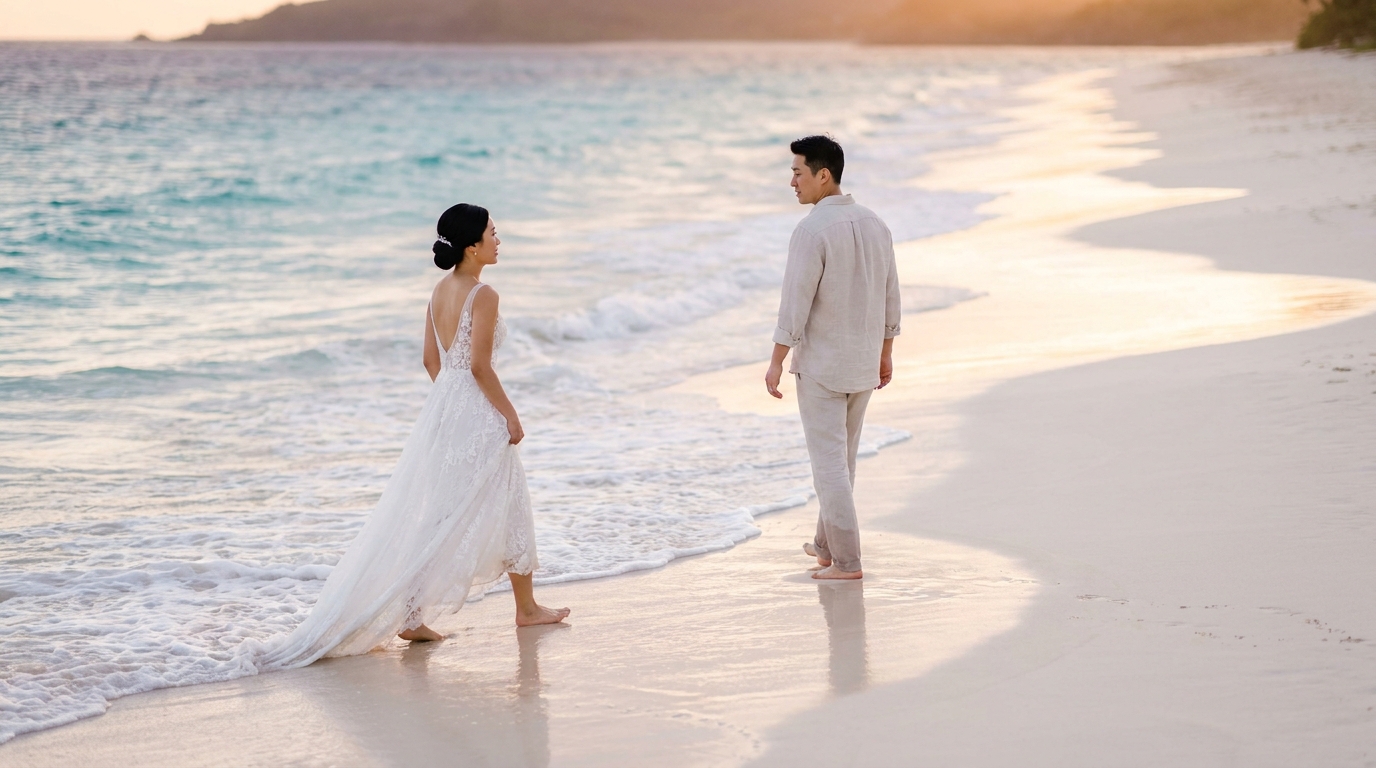
Going barefoot works for casual ceremonies under 30 minutes, but shoes prevent burns on hot sand, protect from shells and debris, and provide stability for formal photos.
The barefoot question comes up in nearly every beach wedding planning conversation. The honest answer depends on your ceremony’s formality, the specific beach conditions, and how long you’ll be standing.
When barefoot actually makes sense
Barefoot ceremonies are acceptable for very casual or explicitly barefoot events, especially on clean, soft sand. [Source: The Knot] If your ceremony is short (under 30 minutes), the sand temperature is comfortable, and you’ve confirmed the beach is free of shells and debris, bare feet can look beautiful and feel natural. Caribbean beach weddings, particularly in Jamaica and Punta Cana, tend to embrace barefoot ceremonies more readily than Mediterranean venues like Santorini.
Hidden risks of going shoeless
Midday sand temperatures in tropical destinations can exceed 120°F, hot enough to cause burns within seconds. Shells, coral fragments, and hidden rocks create injury risks you can’t always spot. Uneven terrain also makes it harder to maintain balance during long photo sessions, especially if you’re wearing a train or holding a bouquet.
The photo consideration: what looks better in wedding albums
Photographers generally report that shoes add a finished look to formal portraits, while barefoot works better for candid, editorial-style shots. The choice depends on your overall aesthetic. If you want both options, many brides slip shoes on for posed portraits and remove them for walking-on-the-beach shots.
Wedges: The Most Reliable Option for Sand
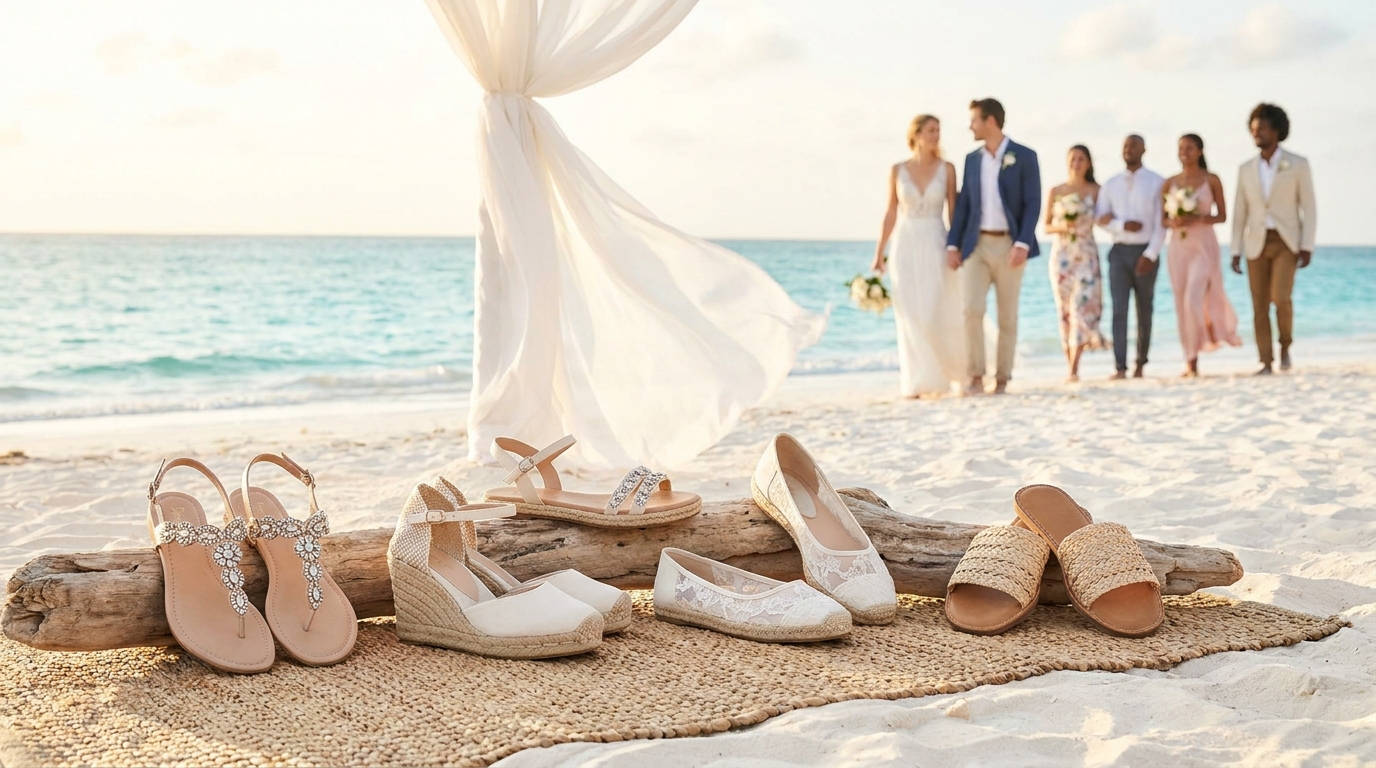
Wedge heels distribute weight across a larger surface area, preventing sinking in sand while providing height. Espadrille and cork wedges perform best in beach conditions.
Charleston Shoe Company calls wedges the “undisputed champion” of beach wedding footwear, noting that the wider sole keeps wearers steady while still looking polished. [Source: Charleston Shoe Co.] That assessment is echoed across nearly every bridal footwear guide.
Why wedges outperform stilettos on sand
The entire bottom of a wedge contacts the ground simultaneously, spreading your weight across several square inches instead of concentrating it on a single point. A bridal stylist quoted by The Knot recommends wedges instead of traditional pumps specifically because they offer more support on sandy terrain. [Source: The Knot]
Best wedge heights for beach terrain
A 2 to 3 inch wedge hits the sweet spot between added height and sand stability. The Knot’s expert guidance warns that even wedges can become too unstable if they are too high or lack a sturdy base. [Source: The Knot] Anything above 3 inches increases ankle-roll risk on uneven sand, particularly during longer ceremonies.
Material choices: espadrille vs. cork vs. wood
Espadrille wedges with jute or raffia wrapping are the most commonly recommended beach option because they’re lightweight and breathable. Cork wedges offer similar stability with better water resistance. Wood wedges look elegant but tend to be heavier and less forgiving on soft sand. For most beach venues, espadrille or cork wedges with ankle straps provide the best combination of security and style.
What About Flat Sandals for Beach Weddings?
Flat sandals with ankle straps work well for casual beach weddings and prevent sand entry, but they lack the formality and height many brides want for photos.
The Knot advises avoiding “anything with a thin heel that can easily sink into the sand” and says a flat sandal is acceptable if it looks considered rather than overly casual. [Source: The Knot] The key word there is “considered.” A plain rubber flip-flop won’t cut it, but a metallic or crystal-accented flat sandal absolutely can.
Gladiator sandals: secure but style-dependent
Gladiator-style sandals with multiple straps offer excellent foot security on sand. The straps prevent your foot from sliding, and the flat sole won’t sink. They work particularly well for bohemian or Mediterranean-inspired beach weddings. The trade-off is that they can look too casual for formal ceremonies and may leave visible tan lines if you’re spending time in the sun before the wedding.
Embellished flats that photograph well
The Knot notes that beach-appropriate flat sandals are often finished with metallics, pearls, or crystal accents to make them feel wedding-appropriate. [Source: The Knot] These details catch light in photos and add visual interest without adding height. Pearl-adorned sandals photograph especially well against white sand.
When flats make more sense than heels
Flats are the smarter choice when you’re on very soft or deep sand, when the ceremony is longer than 45 minutes, or when the terrain includes uneven dunes. They’re also ideal if you and your partner are similar in height and you don’t need the extra inches.
Do Block Heels Work on Sand?
Block heels 2+ inches wide provide better sand stability than stilettos but still sink more than wedges. They work best on packed sand or boardwalk ceremonies.
Block heels are often the safest heel type on sand because they are less likely to sink than stilettos. That said, “less likely” doesn’t mean “won’t sink at all.” Block heels still concentrate weight on a smaller area than wedges do.
Minimum width requirements for sand stability
Industry practitioners typically recommend a block heel width of at least 2 inches for sand use. Anything narrower behaves more like a stiletto on soft surfaces. A block heel with roughly 1 square inch of contact area can still generate significant pressure, enough to sink into loose sand.
Packed sand vs. loose sand performance
Block heels perform reasonably well on packed, wet sand near the waterline. On dry, loose sand further from the water, they sink noticeably. If your ceremony spot is on packed sand or a boardwalk with a sand section, block heels are a viable option. If you’re walking through deep, dry sand to reach the altar, wedges or flats are safer.
Hybrid approach: blocks for photos, barefoot for ceremony
Many brides walk barefoot to the ceremony site, go shoeless during vows, then slip into block heels for portraits on firmer ground. This hybrid approach gives you the elegant heel look in photos without the struggle of walking through sand in them.
Barefoot Sandals: When Do They Actually Work?
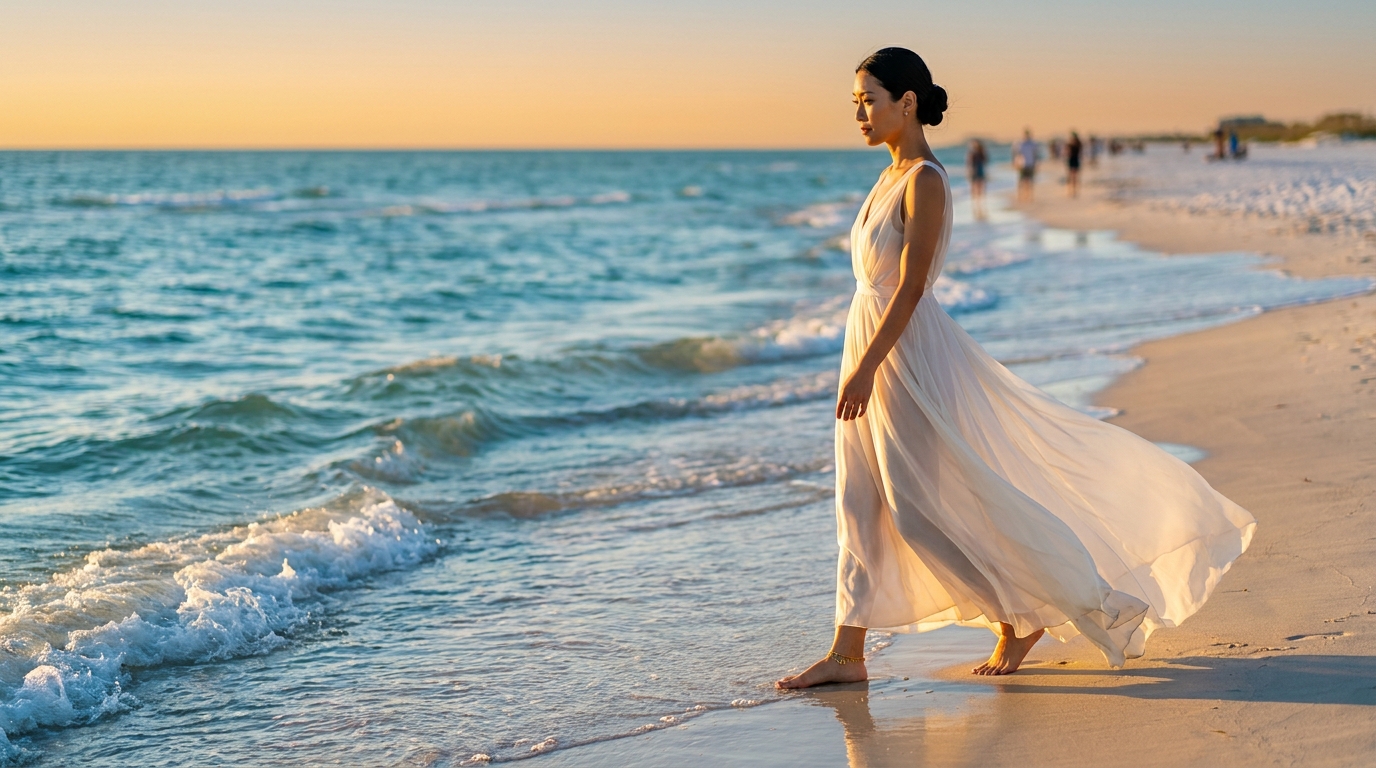
Barefoot sandals (toe jewelry) work only for ultra-casual beach weddings where you’ll be barefoot the entire time. They offer zero protection or stability.
What barefoot sandals actually are
Barefoot sandals aren’t shoes at all. They’re decorative chains or beaded strands that drape over the top of your foot and connect to a toe ring and ankle chain. They create the illusion of footwear in photos while leaving the sole of your foot completely exposed to the sand.
The aesthetic vs. practical tradeoff
They photograph beautifully for close-up foot shots and add sparkle to barefoot portraits. But they provide no cushioning, no protection from hot sand or sharp objects, and no traction. They’re purely decorative.
Best scenarios for barefoot sandals
Barefoot sandals make sense for short, casual ceremonies on clean, cool sand where you’ve confirmed the terrain is safe. They’re popular at Hawaiian and Bali beach weddings with a relaxed vibe. If you’re planning a more formal event or one that involves walking across varied surfaces, they won’t serve you well as your only footwear option.
How Much Should You Spend on Beach Wedding Shoes?
Beach wedding shoes range from $40 to $300, with the $80 to $150 range offering the best balance of quality and value. Avoid ultra-cheap options that won’t survive sand exposure.
Note: all prices are approximate and vary by retailer, region, and season.
Budget tier breakdown
| Price Tier | What You Get | Best For |
|---|---|---|
| $40–$80 | Basic sandals, simple wedges, unembellished flats. Materials may not hold up to saltwater. | Guests, bridesmaids, or brides who plan to go barefoot for most of the event |
| $80–$150 | Better construction, water-resistant materials, comfortable insoles, ankle straps. Many espadrille and cork wedges fall here. | Most beach brides. Best value for sand-specific footwear. |
| $150–$300+ | Designer options, premium leather, hand-embellished details. The Knot’s roundup includes picks up to $750. | Brides who want a keepsake shoe or plan to rewear at other events |
Wedding shoe guides cite a general wedding-shoe average of $100 to $300, with beach-specific styles often landing toward the lower end. [Source: Wedding Forward] The Knot’s beach wedding shoe picks range from $59 to $750, showing the full spectrum of what’s available. [Source: The Knot]
When to invest more vs. save
Invest more if you’ll rewear the shoes, if your ceremony involves extended standing on hot sand (better insoles matter), or if you want a designer pair that doubles as a keepsake. Save if you’re planning to go barefoot for most of the event and only need shoes for the reception, or if your venue’s sand conditions make damage likely regardless of price. And if you want proof that high-fashion looks can survive sand, see how the stars pulled it off at these celebrity beach weddings.
What Shoe Mistakes Do Beach Brides Make?
The biggest beach wedding shoe mistakes are choosing stiletto heels that sink, wearing brand-new shoes without breaking them in, and not having a backup pair for reception.
The stiletto trap: why narrow heels always fail
Wedding shoe experts are unanimous on this point: stilettos sink into sand and increase instability. [Source: Ruxene] A bridal-shoe expert quoted by Diva Catwalk warns that “five-inch stiletto heels will give you rolled ankles and swollen feet.” The allure of a classic stiletto is understandable, but sand physics make them impractical for any beach surface.
Not testing shoes on sand before the wedding day
Multiple bridal shoe guides warn against shoes that haven’t been broken in, emphasizing that you should wear them at least 20 to 30 minutes daily for two weeks before the event. [Source: Get Dream Wedding] Beyond break-in, you should actually test your shoes on sand. Visit a local beach or sandbox and walk around for 10 minutes. You’ll immediately know if your choice works.
Forgetting about the reception venue surface
Your ceremony shoes and reception shoes may need to be entirely different. Sand-friendly wedges can feel clunky on a polished dance floor, while sleek reception heels will fail on sand. Plan for both surfaces from the start.
Ignoring weather and temperature factors
Midday tropical sand can burn bare feet, and afternoon rain showers are common at destinations like Costa Rica and Bali. Choosing shoes that can handle unexpected moisture, or having a waterproof backup pair, prevents a weather surprise from derailing your footwear plan.
How Do You Protect Wedding Shoes from Sand Damage?
Protect beach wedding shoes by applying waterproof spray 48 hours before, avoiding direct saltwater contact, and rinsing with fresh water immediately after. Leather requires extra conditioning post-wedding.
Apply a water-repellent protective spray to fabric or leather shoes well before the wedding day. [Source: Get Dream Wedding] Carry shoes in a dust bag and put them on only when necessary. After the ceremony, gently brush off sand, wipe with the appropriate cleaner, and let shoes air dry completely before storing them in a breathable bag to reduce mildew risk.
Clear rubber heel guards and silicone heel protectors (sometimes called “grass savers”) can also shield soles and sides from sand, moisture, and scratches. These transparent accessories are inexpensive and nearly invisible in photos.
Should You Have Multiple Pairs of Shoes for a Beach Wedding?
Having two pairs, ceremony shoes for sand and reception shoes for dancing, prevents discomfort and damage. In an Easy Weddings poll, 20% of brides planned to switch shoes for a second look.
The Knot’s bridal stylist specifically recommends that brides have “a second pair for the photos that aren’t wet and sandy.” [Source: The Knot] This two-pair strategy is especially smart for destination weddings where your ceremony and reception happen on different surfaces.
In the same Easy Weddings poll, 67% of brides said comfort was “very important” in choosing wedding shoes, while only 8% chose a high or very high heel. [Source: Charleston Shoe Co.] The most popular heel height was medium (44%), followed by small (39%). These numbers reflect a clear trend toward practical footwear, especially for outdoor and beach venues.
Here’s a comparison of how each shoe style performs across the factors that matter most for beach weddings:
| Shoe Style | Sand Stability | Comfort (6+ hrs) | Formality Level | Price Range* | Photo Quality |
|---|---|---|---|---|---|
| Wedges (espadrille/cork) | Excellent | Very Good | Semi-formal to formal | $60–$200 | Excellent |
| Flat sandals (embellished) | Excellent | Excellent | Casual to semi-formal | $40–$150 | Good |
| Block heels (2”+ wide) | Good (packed sand) | Good | Semi-formal to formal | $70–$250 | Very Good |
| Barefoot sandals | N/A (no sole) | Varies (no cushion) | Casual only | $15–$60 | Good (close-ups) |
| Stilettos | Poor | Poor | Formal | $80–$500+ | Good (if standing still) |
| Platform sandals | Very Good | Good | Semi-formal | $50–$180 | Good |
| Ballet flats | Very Good | Very Good | Casual to semi-formal | $30–$120 | Fair |
*Costs vary by retailer, brand, and region. Prices shown are approximate ranges based on 2025 market data.
The global destination wedding market grew from $21.31 billion in 2022 to $28.31 billion in 2023, a 32.8% compound annual growth rate. [Source: Charleston Shoe Co.] With more couples choosing beach venues than ever, the demand for practical, photogenic beach wedding footwear continues to grow alongside it.
Ready to complete your beach wedding look? Browse our destination wedding planning guides for venue recommendations, vendor connections, and real couple stories from beach weddings around the world.