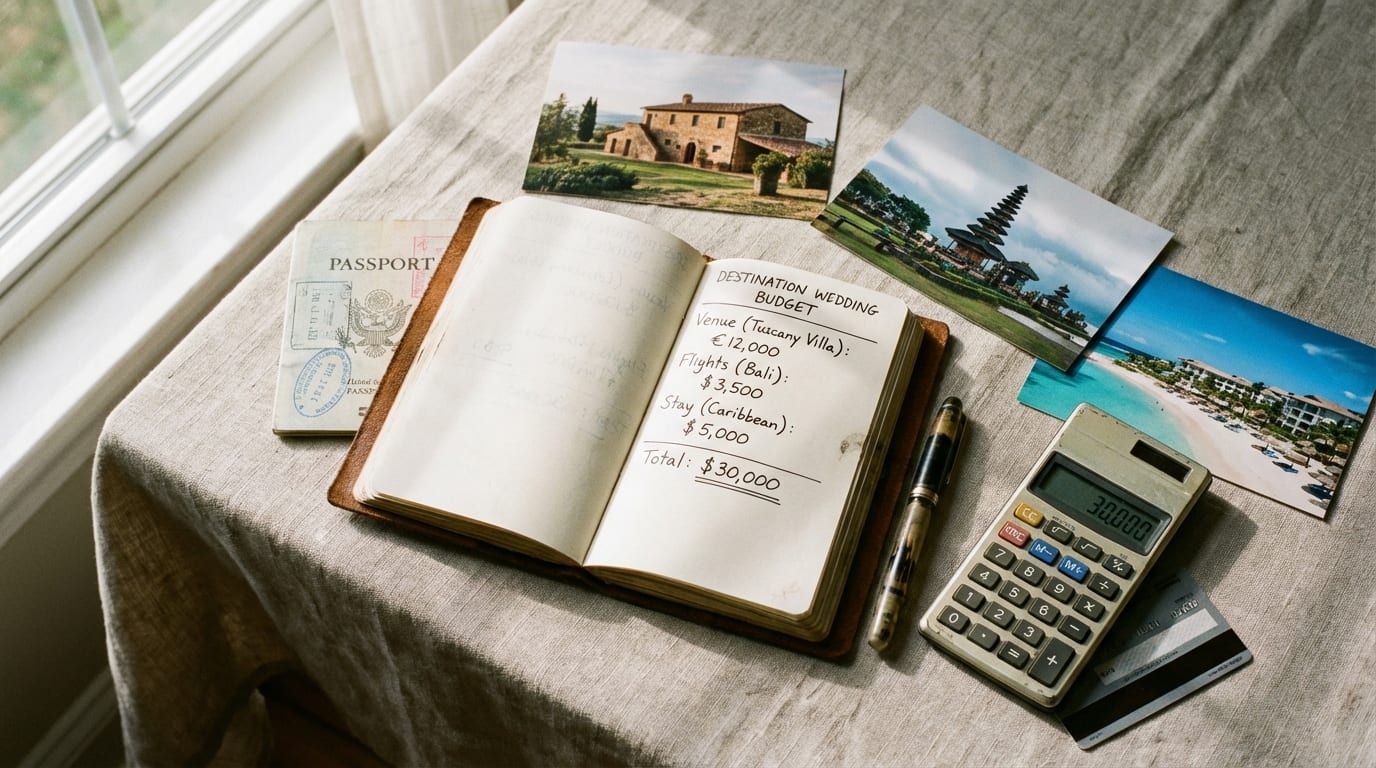
Are destination weddings actually cheaper than traditional weddings?
Destination weddings cost $5,000 to $15,000 for many couples versus $34,200 for the average traditional U.S. wedding, but savings depend entirely on guest count, location, and whether you avoid common budget traps.
The short answer: yes, a destination wedding cheaper than a traditional one is absolutely possible, but it’s not guaranteed. The data tells a complicated story. The Knot’s 2026 Real Weddings Study puts the average U.S. wedding at $34,200, while DestinationWeddings.com reports couples marrying abroad spend roughly $9,850 on average for the wedding experience. [Source: VFL Destination Weddings]
But here’s where it gets messy. The Knot also reports that the average international destination wedding runs $32,100, and a domestic destination wedding hits $36,400, which is actually above the traditional average. [Source: The Knot]
Why the contradiction? “Destination wedding” means wildly different things across sources. A $6,000 all-inclusive package in Cancún and a $50,000 custom celebration in Santorini both qualify. The format you choose, not the label, determines whether you save money. Costs vary by location and season, so treat every figure here as a starting point rather than a guarantee.
What makes destination weddings less expensive?
Smaller guest lists, bundled venue-catering packages, eliminated rental costs, and built-in honeymoon logistics reduce total spending by 40 to 60 percent when executed strategically.
Smaller guest counts drive the biggest savings
Catering can run up to $300 per person at a traditional wedding, so trimming your guest list from 130 to 40 people saves tens of thousands of dollars before you touch any other line item. [Source: Zola] Destination weddings naturally filter attendance because travel is required. WeddingWire data shows the average destination guest list is 94 people versus 132 for hometown weddings. [Source: WeddingWire] That reduction alone reshapes the entire budget.
All-inclusive resorts bundle costs that would be separate line items
A traditional wedding requires separate contracts for the venue, caterer, bartender, coordinator, and often a rental company. All-inclusive resort packages fold many of these into one price. Ceremony space, meals, open bar, basic décor, and a coordinator frequently come standard. [Source: Joy] That bundling eliminates the vendor-coordination overhead that inflates traditional wedding budgets.
You eliminate venue rentals, transportation logistics, and décor expenses
A turquoise ocean backdrop or a Tuscan hillside doesn’t need a $5,000 floral arch to look stunning. Natural scenery replaces paid décor, and the resort itself handles setup and breakdown. You also skip shuttle buses between ceremony and reception, since everything happens in one location. These savings are real but easy to overlook because they’re costs you never see on an invoice.
The honeymoon is already built in
Extending your stay by a few days at the same resort turns your wedding trip into a honeymoon. Zola notes that combining wedding and honeymoon can stretch travel spending further and sometimes unlock added resort perks. [Source: Zola] That’s one less flight, one less hotel booking, and one less week of PTO.
Where destination weddings get more expensive than expected
Travel costs for the couple and immediate family, vendor travel fees, legal requirements, welcome events, and guest accommodation subsidies frequently add $5,000 to $12,000 to initial budget estimates.
Your own travel and accommodation costs
Your own flights and accommodations for the trip can add several thousand dollars to the total. Those costs don’t exist for a hometown wedding. If you’re also flying in parents or grandparents, add another round of tickets.
Bringing vendors vs. using resort vendors
Hiring your favorite photographer from back home means paying their travel, accommodations, and extra shooting days. International travel, equipment shipping, and customs can add 15 to 35% above local rates for photographers, planners, and caterers. Exchange-rate markups and wire fees can tack on another $200 to $1,200. [Source: WeddingWire]
Legal requirements and paperwork fees
Every country has different marriage-license rules, and some require blood tests, waiting periods, or translated documents. These fees are usually modest ($50 to $500), but the logistics can add stress and unexpected costs. Legal requirements change frequently, so confirm current rules with your destination’s consulate or a local wedding planner well before your date.
Guest expectations for multi-day events
When guests fly across an ocean, a single ceremony and reception can feel abrupt. Most destination weddings expand into welcome dinners, pool days, and farewell brunches. Those extras can add $0 to $8,000+ in hidden subsidies depending on how much you cover. [Source: KHOU/NerdWallet]
The hidden cost of lower attendance
A smaller guest list saves money on catering, but it can also mean fewer gifts. 27% of Americans say attending a destination wedding would make them spend less on a gift than their usual budget. [Source: KHOU/NerdWallet] If you’re counting on registry gifts to offset costs, factor this in.
Destination wedding vs. traditional wedding: cost breakdown by category
Destination weddings save 60 to 80% on venue and catering but cost significantly more on travel and accommodations. Net savings emerge most reliably when guest count drops below 60 people.
Here’s a destination wedding cost comparison showing where money goes in each format. All figures are approximate ranges based on 2025-2026 industry data. Costs vary by location and season.
| Category | Traditional Wedding (130 guests) | Destination Wedding (40 guests) | Key Difference |
|---|---|---|---|
| Venue | $5,000 - $15,000 | $0 - $3,000 (often bundled) | Resort packages include ceremony space |
| Catering & bar | $10,000 - $25,000 | $2,000 - $6,000 (often bundled) | Fewer guests + all-inclusive pricing |
| Photography & video | $3,000 - $7,000 | $3,000 - $8,000 | Comparable, or higher if flying in vendors |
| Flowers & décor | $2,000 - $6,000 | $500 - $2,500 | Natural scenery reduces décor needs |
| Attire & beauty | $2,000 - $5,000 | $2,000 - $5,000 | Roughly equal |
| Couple’s travel & lodging | $0 - $500 | $2,000 - $5,000 | Major destination-specific cost |
| Honeymoon | $3,000 - $8,000 (separate trip) | $0 - $2,000 (extend the stay) | Built-in honeymoon saves a second trip |
| Welcome events & extras | $0 - $1,000 | $1,000 - $5,000 | Multi-day events add up |
| Estimated Total | $25,000 - $67,500 | $10,500 - $36,500 |
Sources for this table draw on data from [Source: VFL Destination Weddings], [Source: Zola], and [Source: Destify]. Ranges reflect budget-to-moderate tiers. Luxury weddings in either format can exceed these figures substantially.
Venue and catering: where destination weddings win
This is where the destination wedding budget breakdown looks most favorable. All-inclusive packages frequently bundle ceremony space, food, drinks, and coordination into one price. One source reports that couples can get a full wedding package in Cabo or Riviera Maya for less than $10,000 for 40 to 50 people. [Source: VFL Destination Weddings]
Photography and videography: comparable or higher
If you use the resort’s in-house photographer, costs may be similar. If you fly in a preferred vendor, expect to cover their flights, hotel, meals, and extra shooting days. That can push photography 15 to 35% above what you’d pay locally.
Flowers and décor: depends on import costs
Tropical destinations often have gorgeous local flowers at lower prices. But if you want peonies on a Caribbean island, import costs can spike. Work with local florists who know what grows nearby.
Attire and beauty: roughly equal
Your dress, suit, alterations, and hair and makeup cost about the same regardless of location. The main difference: destination brides often choose lighter, less formal gowns that can cost less, though that’s a style choice, not a location-driven saving.
Travel and accommodations: where costs spike
This is the category that can erase your savings. For guests traveling to Mexico, Paradise Weddings estimates $500 to $1,000 per person in travel costs. [Source: Paradise Weddings] Destify estimates that for a destination wedding with 30 guests, accommodation alone can add $2,100 to $4,000 in guest-related spending. [Source: Destify]
The real comparison: 150-guest traditional vs. 40-guest destination
When you compare apples to apples, the question of how much does a destination wedding cost almost always comes back to guest count. A 40-guest destination wedding in Mexico at $12,000 versus a 150-guest traditional wedding at $34,200 shows clear savings. But a 100-guest destination wedding in Italy can easily exceed $50,000. The destination doesn’t save you money. The smaller scale does.
Which destinations offer the best value for budget-conscious couples?
Mexico and the Dominican Republic deliver the lowest all-in costs at $5,000 to $15,000 for 30 to 40 guests, while Hawaii and Europe typically run $20,000 to $50,000+ for comparable celebrations.
Mexico and the Caribbean: highest value per dollar
Mexico is the most consistently cited best-value destination across wedding industry sources. Destination wedding packages in Mexico can start at $5,000 for 20 to 30 guests. [Source: The Budget Savvy Bride] DestinationWeddings.com notes that Punta Cana, Cancún, and Riviera Maya “consistently offer the lowest entry points,” with the Dominican Republic averaging $8,959 for a wedding. Jamaica falls slightly higher at an estimated $900 to $1,300 per guest but remains budget-friendly. If your total wedding budget is under $5,000, the best bets are Punta Cana, Cancún, or Riviera Maya. For $5,000 to $10,000, consider Puerto Vallarta, Montego Bay, or Tulum.
Hawaii: mid-range pricing with easier logistics
Hawaii offers a domestic destination option, which means no passports, no currency exchange, and no international legal hurdles. But pricing sits in the mid-range. Expect $20,000 to $35,000 for a 40-guest wedding. The tradeoff is convenience: your guests can use miles, there’s no language barrier, and planning a Hawaii wedding involves fewer logistical surprises.
Europe: beautiful but budget-intensive
Portugal offers relative value for Western Europe, with all-inclusive packages around $5,000 to $10,000 for 50 guests and venue rentals starting as low as $3,500. Georgia stands out as the budget-friendly European option, where many couples spend under $7,000 for a full-service celebration. [Source: The Budget Savvy Bride] Italy, Greece, and France, however, can push well past $50,000. Zola estimates European destination weddings can reach $50,000+. [Source: Zola]
What drives destination pricing differences
Three factors explain most of the variation: local labor costs, resort competition density, and exchange rates. Mexico has hundreds of resorts competing for wedding business, which drives prices down. Santorini has limited venues and massive demand, which drives prices up. Favorable exchange rates in countries like Colombia (where one source reports average wedding costs of roughly €4,597 (about $5,200)) can stretch your dollar further.
How to make a destination wedding cheaper without sacrificing quality
Book 12 to 18 months ahead for group rates, choose Friday or Sunday ceremonies, use resort vendors, limit welcome events to one, and negotiate room block minimums to cut costs 25 to 40%.
Timing: off-season and weekday weddings
Joy reports 20 to 50% savings on accommodations during low season, and Zola says late spring and early fall can produce 25 to 40% savings while keeping decent weather. [Source: DestinationWeddings.com] Friday or Sunday ceremonies can cut venue fees by up to $4,000 compared to Saturday events. Peak-season pricing can increase destination wedding costs by as much as 40%. [Source: Zola]
Guest list strategy: quality over quantity
Every additional guest adds catering, favors, seating, and coordination costs. The sweet spot for budget-conscious destination weddings is 30 to 50 guests. At that size, you get the intimacy that makes destination weddings special without the per-head costs that balloon traditional budgets.
Resort vendor packages vs. outside vendors
Using local vendors avoids travel and shipping surcharges. Zola advises using local vendors to get quality aligned with the destination while avoiding the 15 to 35% premium of flying in outside professionals. [Source: Zola] DestinationWeddings.com recommends choosing resorts where the complimentary package already covers ceremony, décor, cake, champagne, and a coordinator, then adding only a few high-impact upgrades. [Source: DestinationWeddings.com]
Group rates and room block negotiations
Most resorts offer group rates when you book a block of 10+ rooms. These rates can save your guests 20 to 40% on nightly rates, and some resorts throw in perks for the couple (room upgrades, spa credits, or complimentary welcome cocktails) when room block minimums are met. Start negotiations early, as the best blocks go fast during popular months.
What to splurge on vs. what to skip
Splurge on photography (you’ll look at those photos for decades) and food quality (your guests traveled far, so feed them well). Skip elaborate centerpieces, printed programs, and multi-event welcome weekends. One welcome dinner is generous. Three days of planned activities is a second wedding budget.
What about guest costs, are you just shifting expenses to attendees?
Guests spend $500 to $2,500 per person on destination wedding travel versus $300 to $700 for local weddings, but many report preferring destination weddings because they combine celebration with vacation.
This is the question that deserves honest treatment. The Knot reports that the average cost for guests attending a destination wedding is $673 per person, compared with $703 for a traditional wedding, though that comparison depends heavily on location and travel assumptions. [Source: Travel Bash] For guests traveling to Mexico specifically, Paradise Weddings estimates $500 to $1,000 per person. [Source: Paradise Weddings]
The financial burden is real. 27% of Americans say attending a destination wedding would make them spend less on a gift. [Source: KHOU/NerdWallet] Some guests simply can’t afford it, and that’s okay. The key is transparency: give guests 8 to 12 months’ notice, share estimated travel costs upfront, and make it genuinely clear that you understand if they can’t attend.
That said, many guests view destination wedding travel as a vacation they’d want to take anyway. When you frame the trip as an opportunity rather than an obligation, and when you choose a destination with affordable flights and good resort value, most guests appreciate the experience. The etiquette standard is clear: you are not expected to pay for guest travel. You are expected to be gracious about declines.
When a destination wedding costs more than a traditional wedding
Destination weddings exceed traditional wedding costs when guest counts surpass 80 people, when couples subsidize guest travel, or when luxury European locations replace budget-friendly Caribbean options.
Credibility requires saying this plainly: destination weddings are not always the cheaper option. Here’s when the math flips against you:
-
Guest count above 80. At that point, you’re paying destination-level travel costs while also covering catering for a crowd. WeddingWire reports destination weddings average $32,000 for couples versus $28,600 for hometown weddings when guest lists stay large. [Source: WeddingWire]
-
Subsidizing guest travel or lodging. Covering hotel blocks, airport transfers, or welcome dinners for 50+ guests can add $5,000 to $12,000 to your budget.
-
Luxury European destinations. A wedding in Amalfi, Santorini, or the French Riviera can easily hit $50,000+, which exceeds most traditional U.S. wedding budgets.
-
Package upgrades that snowball. A quoted “all-inclusive” package often leaves out alcohol upgrades, premium photography, florals, transportation, permits, and gratuities, which can push the final bill well above the advertised price.
-
International coordination overhead. One statistics roundup estimates planning expenses can run 15 to 20% higher for overseas weddings because of coordination complexity. [Source: VFL Destination Weddings]
The honest takeaway: destination weddings save money when they’re small, bundled, and in budget-friendly locations. They cost more when they try to replicate a full-scale traditional wedding in a more expensive setting.
Ready to explore whether a destination wedding fits your budget? Browse our destination guides for Mexico, Caribbean, Hawaii, and Europe to see real venue costs, vendor pricing, and guest accommodation options.