What Makes Destination Wedding Invitation Text Different From Traditional Wording?
Destination wedding invitations must balance formality with logistics, clearly stating the location’s country or region and signaling that travel is required without overwhelming the main card with details.
Destination weddings are common enough now that your guests have likely received an invitation to one before, and they’ll notice when critical information is missing. Traditional invitation templates assume everyone lives within driving distance. Your destination wedding invitation text needs to do more: communicate a specific international or remote location, signal that travel planning is required, and point guests toward detailed logistics, all while maintaining the elegance of a formal invitation.
The three-part structure that works: ceremony details, location context, and where to find more
The most effective destination wedding invitations follow a three-part framework:
-
Formal ceremony details: Names, date, time, venue name, and full location (city and country). This mirrors traditional etiquette exactly.
-
Location context: A brief line that grounds the venue geographically, especially when the venue name alone doesn’t communicate the destination.
-
Reference to complete information: A single line directing guests to your wedding website or enclosed details card for travel logistics, hotel blocks, and itinerary.
This structure keeps the main card clean and formal while ensuring no guest is left wondering where to find flight information or hotel booking codes.
Why “destination wedding” shouldn’t appear on the invitation itself
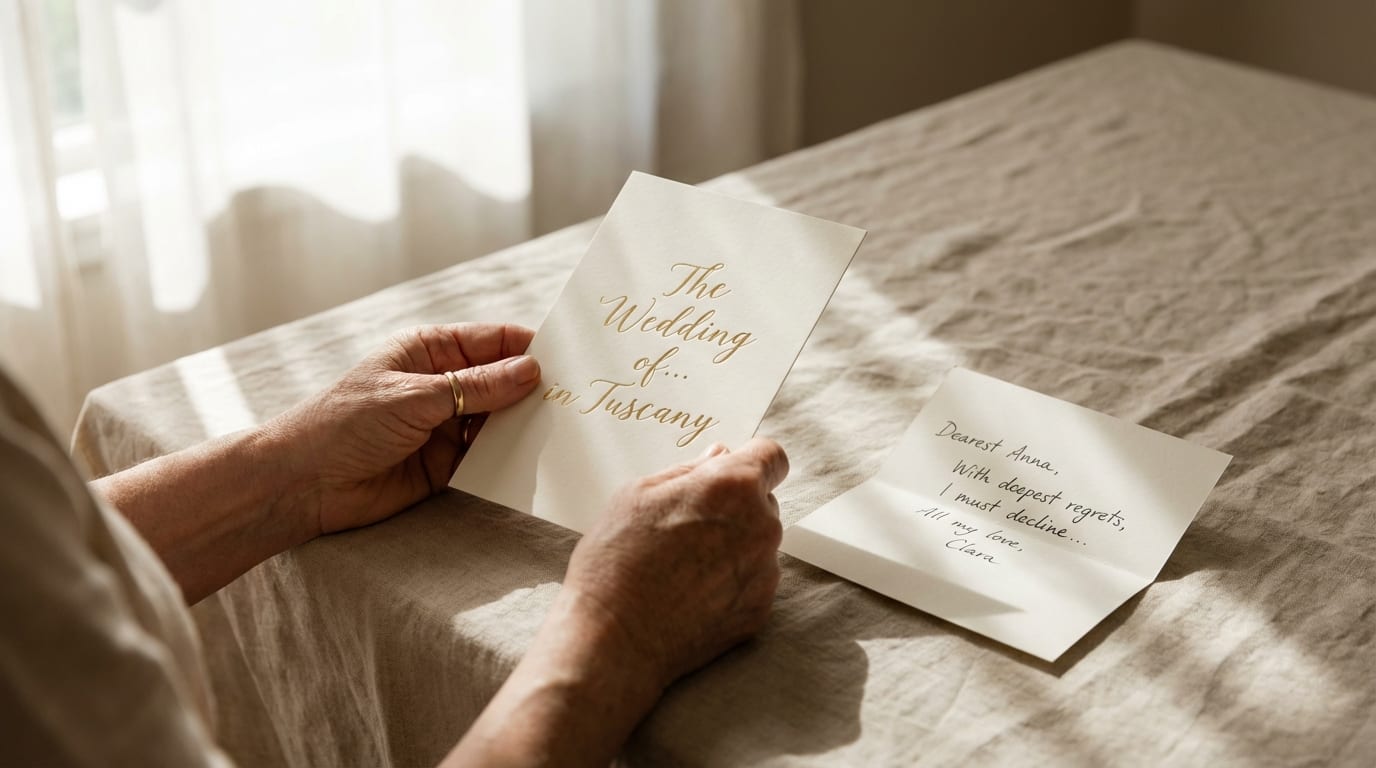
You don’t need to label your event a “destination wedding.” The city and country line does that work for you. Writing “destination wedding” on the invitation feels redundant and slightly informal. Phrases like “We invite you to join us in Tulum” or “Together with their families, they request the pleasure of your company in Tuscany” signal the destination while staying elegant [Source: Bliss & Bone]. Let the location speak for itself.
What Information Must Appear on the Invitation Card Itself?
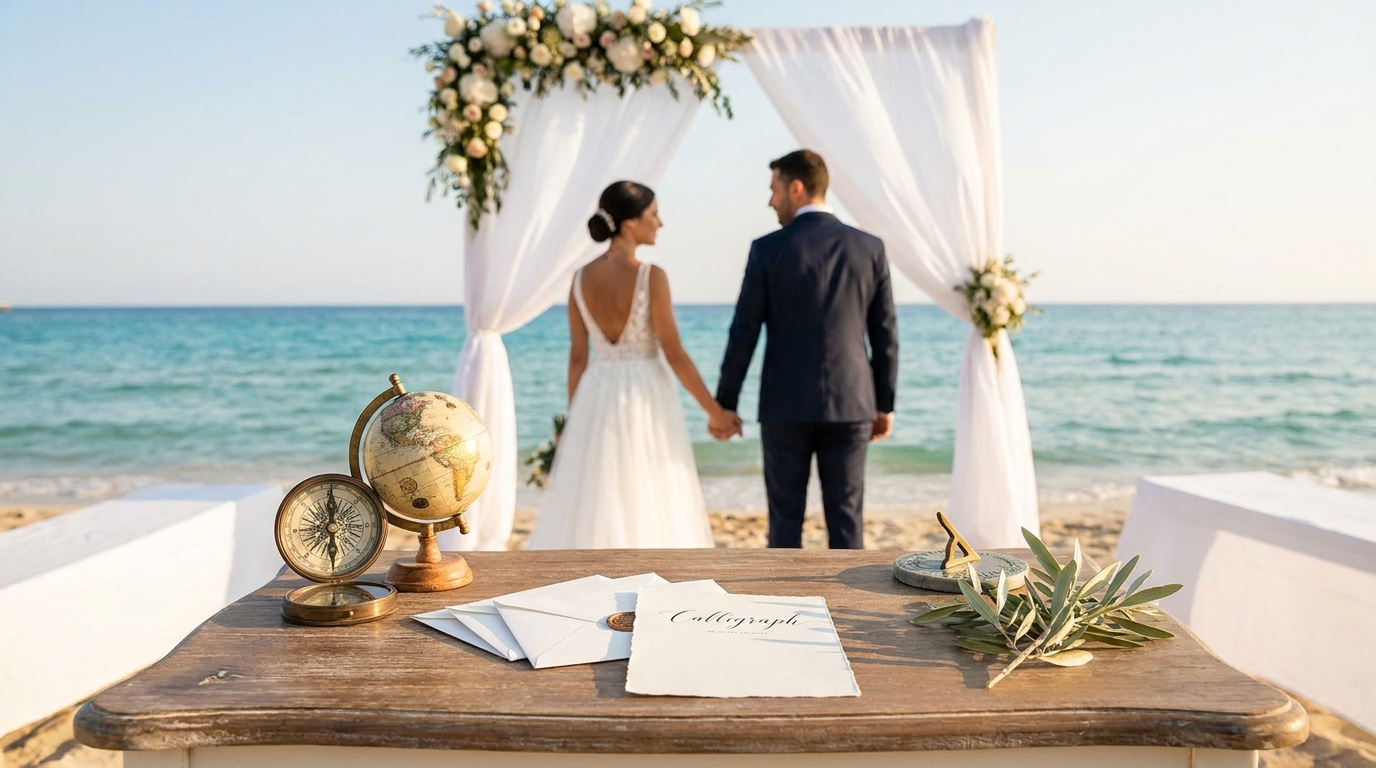
The invitation card must include names, ceremony date and time, venue name, city and country, and a reference to additional details on a separate card or wedding website.
The non-negotiables: date, time, venue, and full location (city + country)
Every destination wedding invitation needs these elements on the main card:
-
Host line (parents’ names, couple’s names, or both)
-
Request line (“request the pleasure of your company” or similar)
-
Full names of both partners
-
Date, spelled out formally
-
Time of ceremony
-
Venue name
-
City and country (never assume guests know where your resort is)
-
Reception line (“Reception to follow” or similar)
One common mistake flagged by multiple etiquette experts is omitting the country name. “Secrets Resort” means nothing without “Cancún, Mexico” beneath it [Source: Studio Creative Things].
What to do when your venue name isn’t self-explanatory
If your venue is a private villa, estate, or lesser-known property, add a brief geographic anchor. For example: “Villa Ariadne, Oia, Santorini, Greece.” The venue name alone won’t help guests book flights to the right island. If you’re planning a Santorini wedding, this specificity matters even more because the island has multiple towns with very different vibes.
How to reference your wedding website without cluttering the design
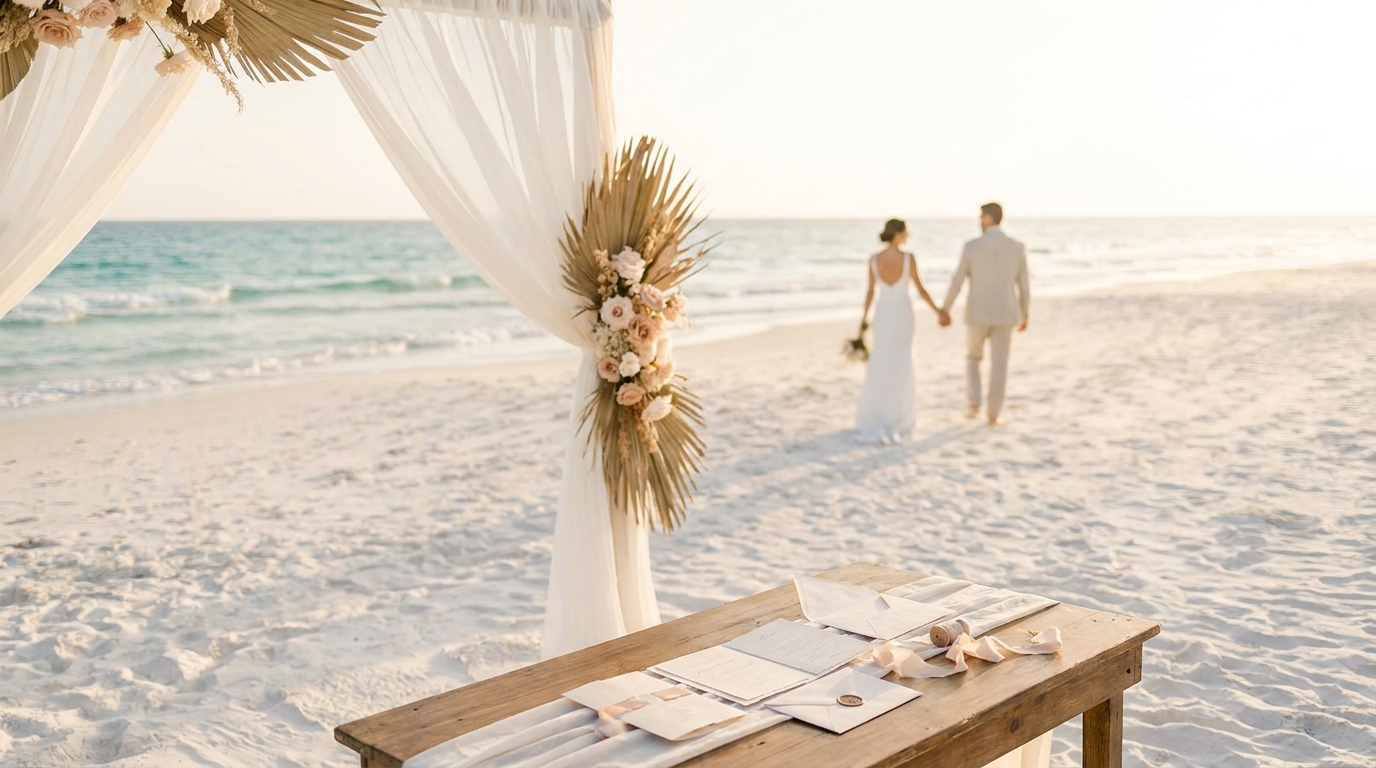
A single line at the bottom of the invitation works best: “For travel details and accommodations, please visit [YourWebsite.com].” Keep the URL short and memorable. Avoid QR codes on the main invitation card if you’re going for a formal look. Save those for insert cards.
Should You Include Travel Details on the Invitation or a Separate Insert?
Travel logistics belong on separate insert cards or your wedding website, not the main invitation, to maintain formality and prevent information overload on the primary card.
Here’s why this matters: only 50-60% of invited guests typically attend destination weddings, compared with 80-85% for local weddings [Source: Experian]. Clear, well-organized travel information can help borderline guests decide to attend. But cramming that information onto the main card backfires. Experts consistently caution against stuffing extras like hotel details, breakfast schedules, or activity lists onto the invitation itself [Source: Studio Creative Things].
What goes on insert cards: hotel blocks, booking deadlines, and group codes
Your details insert card should include:
-
Hotel or resort name and room block code
-
Booking deadline for group rates
-
Nearest airport code
-
A brief note about transportation from airport to venue
-
Your wedding website URL for full details
Information that belongs exclusively on your wedding website
Reserve these for your website only: full itinerary, restaurant recommendations, packing suggestions, excursion options, registry information, and detailed maps. This is also where you can link to your destination wedding planning checklist so guests understand the full timeline.
The one travel detail you should include on the main card (and when)
If your wedding requires guests to stay at a specific resort, that detail belongs on the main card. When attendance depends on booking at a particular property, guests need to know immediately, not after clicking through a website.
How Do You Word a Destination Wedding Invitation for a Resort Wedding?
Resort wedding invitations should name the specific resort, include the city and country, and reference room block details on a separate card rather than listing resort amenities.
Example wording for all-inclusive resort weddings
Here’s a copy-paste ready example [adapted from Source: WedSites]:
Together with their families
Emma Carter and Liam Rodriguez
request the honor of your presence
at their wedding celebration
at Dreamscape Resort & Spa
Punta Cana, Dominican Republic
on Saturday, the twenty-third of May
two thousand twenty-seven
at four o’clock in the afternoon
Reception to follow at the resort
Kindly reply by March 1
via our website: EmmaAndLiam2027.com
How to handle invitations when guests must stay at your resort
When your venue requires on-site accommodation, add a line like: “Guest accommodations are reserved at [Resort Name]. Please visit [website] for booking details.” This is factual, not pushy, and gives guests the information they need without turning the invitation into a booking form.
Wording adjustments for adults-only vs. family-friendly resorts
For adults-only resorts, a line on the details card reading “This celebration is an adults-only occasion” is clearer and kinder than addressing envelopes without children’s names and hoping guests figure it out. For family-friendly resorts, you might add: “Children are welcome. Kids’ activities are available at the resort.”
What’s the Right Tone for Destination Wedding Invitation Text?
Destination wedding invitations should maintain traditional formality in structure while using warm, clear language that acknowledges the travel commitment without apologizing for it.
Formal vs. casual wording: what actually matters to guests
A 2024 survey by The Wedding Report found that 72% of destination wedding guests say advance notice is the primary factor in whether they can attend [Source: Paperlust]. Guests care far more about clarity and timing than whether you write “request the honour of your presence” or “invite you to celebrate.” Match your tone to your event. A barefoot ceremony in Jamaica doesn’t need the same language as a cathedral wedding in Italy.
Expert guidance suggests three tonal ranges [Source: Bliss & Bone]:
-
Formal: “Together with their families, [Names] request the pleasure of your company at their wedding in Tuscany.”
-
Warm and relaxed: “Join us for a weekend in the sun as we say ‘I do’ in Tulum.”
-
Balanced: “Please join us in celebrating the marriage of [Names] in [Destination], [Date].”
How to acknowledge the travel ask without sounding apologetic
Avoid phrases like “We know it’s a lot to ask” or “We understand if you can’t make it.” These undermine the celebration and signal uncertainty. Instead, frame the destination as intentional and joyful: “We would be honored to have you join us in Costa Rica” communicates warmth without apology.
When to break traditional etiquette rules (and when not to)
Traditional etiquette says nothing about hotel blocks, airport codes, or passport reminders. You can, and should, break from convention by including a details card with travel logistics. But keep the main invitation card itself structurally traditional: host line, request line, names, date, time, venue, location. That familiar structure gives guests an instant understanding of the event’s formality.
How Do You Address Multi-Day Destination Weddings in Invitation Text?
Multi-day destination wedding invitations should feature the main ceremony prominently, then reference additional events on a separate itinerary card or website to avoid confusion about what’s required.
Wording when the wedding spans three or more days
The main invitation covers only the ceremony and reception. A separate “Weekend Events” card lists everything else with dates, times, and locations. This prevents guests from feeling obligated to attend every event or confused about which gathering is the actual wedding.
How to indicate which events are optional vs. required
Use language like “You’re warmly invited to join us for” before optional events and reserve “Please join us for” for the ceremony. On your itinerary card, a simple asterisk noting “All events are optional except the ceremony and reception” removes ambiguity.
Example text for welcome dinners and day-after brunches
Welcome Dinner
Friday, May twenty-second
seven o’clock in the evening
Beachside Terrace, Dreamscape Resort
Casual resort attire
Farewell Brunch
Sunday, May twenty-fourth
ten o’clock in the morning
The Garden Pavilion
Come as you are
What Dress Code Language Works for Beach and Tropical Destination Weddings?
Beach destination wedding dress codes should specify “beach formal,” “tropical cocktail,” or “resort elegant” rather than traditional terms, with fabric and footwear guidance on your website.
Why “beach formal” is clearer than “cocktail attire” for sand ceremonies
“Cocktail attire” conjures stilettos and structured fabrics, neither of which works on sand. “Beach formal” immediately tells guests to dress up while accounting for the setting. Other effective terms include “tropical elegant,” “island formal,” and “resort chic.”
How to communicate dress code without dictating specific outfits
On your details card or website, add a line like: “Beach formal attire suggested. Light fabrics and flat or wedge shoes are recommended for our sand ceremony.” This gives guidance without micromanaging.
When to include dress code on the invitation vs. website only
If your dress code is non-standard (anything beyond “formal” or “semi-formal”), include it on the details insert card. Save longer explanations for the website. Never put dress code on the main invitation card itself.
How Do You Handle RSVP Deadlines for Destination Weddings?
Destination wedding RSVP deadlines should be set 6-8 weeks before the wedding date, clearly stated on the RSVP card, with a note that early responses help guests secure better travel rates.
Destination weddings with less than 4 months’ notice see RSVP completion drop by 22% compared with weddings announced at 5 or more months out [Source: The Perfect Wedding]. That’s a significant gap, and it underscores why timing matters so much.
| Timeline Element | Recommended Timing | Source |
|---|---|---|
| Save-the-dates | 9-12 months before wedding | Loud Bride |
| Formal invitations mailed | 4-6 months before wedding | Loud Bride |
| RSVP deadline | 6-8 weeks before wedding (10-12 weeks for complex international travel) | The Perfect Wedding |
| Hotel block booking deadline | Typically 30-60 days before wedding (varies by property) | Industry standard |
Why destination wedding RSVPs need earlier deadlines (and how much earlier)
Standard wedding RSVP deadlines run 3-4 weeks before the event. Destination weddings need 6-8 weeks minimum because your venue, caterer, and hotel block all require final counts earlier. More conservative guidance recommends 10-12 weeks when travel is complex [Source: The Perfect Wedding].
Wording that motivates guests to respond promptly without pressure
The strongest RSVP wording ties the deadline to a tangible benefit for the guest:
-
“To secure group room rates and travel arrangements, kindly respond by [date].”
-
“Final guest count due by [date].”
-
“Please RSVP by [date] to ensure your reservation in our room block.”
The “final count due by” version works especially well because it signals the deadline is firm and tied to logistics, not just courtesy [Source: Loud Bride].
What to do when you need RSVPs before sending formal invitations
Some venues require headcounts before your formal invitation timeline. In these cases, send a preliminary response request with your save-the-date, framed as: “To help us plan accommodations, please let us know by [date] if you anticipate attending.” Follow up with the formal invitation and RSVP card later.
Save the Dates from Minted
Photo save the dates, magnets, and postcards designed by independent artists. Order 6+ months out for best price tiers and free recipient addressing.
Free guest address printing on orders 50+.
Browse Save the DatesWhat Legal or Travel Warnings Belong in Destination Wedding Invitation Text?
Passport validity requirements and travel advisory notices belong on your wedding website or a separate information card, not the formal invitation, with a simple website reference on the main card.
Note: Travel requirements, visa policies, and health regulations change frequently. Always direct guests to official government sources for the most current information.
How to reference passport requirements without legal language on the invitation
On your details card, a simple line works: “A valid passport is required for travel to [country]. Please ensure yours is current through [date, six months after the wedding].” This is helpful without being legalistic.
When to include visa information (and how to word it)
If any of your guests may need visas, include a line on your details card: “Some nationalities may require a visa to enter [country]. Please check entry requirements for your passport.” Then provide a link to the relevant embassy or government website on your wedding website.
Handling travel insurance and health requirement communications
Trip Protection for Your Wedding Party
Cover flights, hotels, and medical emergencies for your entire guest list. Cancel-for-any-reason options ideal for destination weddings.
A+ rated insurer. Group plans available for wedding parties.
Compare PlansTravel insurance and vaccination requirements belong exclusively on your wedding website. These details are too lengthy and too variable for printed materials. A brief mention on the details card, such as “Travel insurance is recommended. See our website for health and entry information,” covers your bases.
12 Destination Wedding Invitation Text Examples That Work
Effective destination wedding invitation examples include formal traditional wording, casual beach ceremony text, resort wedding language, and multi-day celebration formats, all clearly stating location and referencing additional details separately.
Formal destination wedding wording (international locations)
Example 1: Classic Formal
Mr. and Mrs. David Chen
request the honour of your presence
at the marriage of their daughter
Sophia Marie
to
James Andrew Whitfield
son of Mr. and Mrs. Robert Whitfield
on Saturday, the fourteenth of June
two thousand twenty-seven
at half past four in the afternoon
Villa Cimbrone
Ravello, Italy
Reception to follow
For travel details, please visit
SophiaAndJames.com
Example 2: Formal, Couple-Hosted
Together with their families
Aisha Patel
and
Marcus Thompson
request the pleasure of your company
at their marriage
on Friday, the tenth of October
two thousand twenty-seven
at five o’clock in the evening
Ayana Resort and Spa
Jimbaran, Bali, Indonesia
Dinner and dancing to follow
Please visit AishaAndMarcus.com
for accommodation and travel details
Casual beach ceremony invitation text
Example 3: Relaxed Beach
Megan O’Brien and Carlos Reyes
invite you to celebrate their marriage
on the shores of Tulum, Mexico
Saturday, March seventh
two thousand twenty-seven
at four o’clock in the afternoon
La Zebra Beach Club
Dinner and celebration to follow on the beach
Beach formal attire suggested
Details at MeganAndCarlos.com
Example 4: Warm and Simple
With joy and love
Hannah Brooks and Daniel Kealoha
invite you to their wedding
Saturday, the ninth of August
two thousand twenty-seven
at five o’clock in the evening
Haiku Mill
Maui, Hawaii
Reception to follow
Travel and accommodation details at
HannahAndDaniel.com
All-inclusive resort wedding examples
Example 5: Resort Wedding, Formal
Together with their families
Rachel Simmons and David Ortega
request the honor of your presence
at their wedding celebration
at Sandals Royal Barbados
St. Lawrence Gap, Barbados
on Saturday, the fifteenth of February
two thousand twenty-seven
at four o’clock in the afternoon
Reception to follow at the resort
Kindly reply by December 1
Details at RachelandDavid.com
Example 6: Resort Wedding, Modern
Olivia Tran and Ethan Morales
are getting married
at Excellence Playa Mujeres
Cancún, Mexico
Saturday, November first
two thousand twenty-seven
at five in the evening
Please join us for dinner and dancing after the ceremony
Room block and travel info at
OliviaAndEthan.com
Multi-day celebration wording
Example 7: Weekend Celebration
Lauren Mitchell and Ryan Nakamura
invite you to celebrate their wedding weekend
October third through fifth
two thousand twenty-seven
in Montego Bay, Jamaica
The ceremony will take place on Saturday, October fourth
at four o’clock in the afternoon
at Round Hill Hotel and Villas
A full weekend itinerary is available at
LaurenAndRyan.com
Intimate destination wedding text (under 30 guests)
Example 8: Small Gathering, Warm Tone
Claire Dubois and Thomas Engel
would be honored by your presence
as they exchange vows
among their closest family and friends
on Thursday, the twentieth of September
two thousand twenty-seven
at three o’clock in the afternoon
Canaves Oia Suites
Santorini, Greece
Intimate dinner to follow
Please visit ClaireAndThomas.com
for travel arrangements
Example 9: Elopement-Style with Guests
We’re getting married in Costa Rica
and we want you there
Priya Sharma and Ben Calloway
Saturday, the twelfth of April
two thousand twenty-seven
at four o’clock
Nayara Springs
La Fortuna, Costa Rica
Everything you need to know is at
PriyaAndBen.com
Wording when you’re covering guest accommodations
Example 10: Couple Covering Accommodations
Jessica Moreau and Andre Williams
joyfully invite you to their wedding
on Saturday, the sixth of December
two thousand twenty-seven
at half past four in the afternoon
Hotel Xcaret Arte
Playa del Carmen, Mexico
Accommodations for all guests have been arranged at the resort
for December fifth through eighth
Please visit JessicaAndAndre.com
for travel details and to confirm your stay
Example 11: Partial Coverage
Together with their families
Natalie Kim and Jordan Ellis
request the pleasure of your company
at their wedding
Saturday, the seventeenth of May
two thousand twenty-seven
at five o’clock in the evening
Sugar Beach, A Viceroy Resort
Soufrière, Saint Lucia
Two nights’ accommodation is provided for all guests
Additional nights available at a group rate
Kindly reply by March 1
Full details at NatalieAndJordan.com
Example 12: Formal with Covered Stay
Mr. and Mrs. William Hayes
request the honour of your presence
at the marriage of their daughter
Catherine Elizabeth
to
Michael James Brennan
on Saturday, the twenty-second of March
two thousand twenty-seven
at four o’clock in the afternoon
Four Seasons Resort Hualalai
Kailua-Kona, Hawaii
Guest accommodations have been arranged
for March twenty-first through twenty-third
Reception to follow
Details at CatherineAndMichael.com
What Are the Most Common Destination Wedding Invitation Wording Mistakes?
Common mistakes include overloading the main card with logistics, using apologetic language about the travel requirement, omitting the country name, and failing to reference where guests find complete information.
Information overload: when “helpful” becomes overwhelming
One destination wedding guide identifies 7 common mistakes couples make, and overloading the invitation ranks near the top [Source: Studio Creative Things]. Sunscreen reminders, breakfast schedules, excursion options, and registry details do not belong on the invitation or even the details card. That’s what your website is for.
The apology trap: why “we know it’s a lot to ask” undermines your event
More than 1 in 3 invited guests (35%) decline destination wedding invitations, primarily due to cost and logistics [Source: Experian]. That’s a reality of destination weddings, and apologizing for it on the invitation doesn’t change the math. It only makes your event feel like an imposition rather than a celebration. State the location with confidence and let guests make their own decisions. For the guest’s side of that decision, see our take on declining a destination wedding invitation.
Assuming guests know where your venue is located
Experts recommend including the full venue or resort name so guests know exactly where to go [Source: Studio Creative Things]. “Near Cancún” is too vague. “Excellence Playa Mujeres, Cancún, Mexico” is specific and actionable. Always include city and country, even for well-known destinations.
How Far in Advance Should Destination Wedding Invitations Be Sent?
Destination wedding invitations should be mailed 4-6 months before the wedding date, with save-the-dates sent 9-12 months prior to give guests maximum planning time for travel arrangements.
A 2024 survey found that 72% of destination wedding guests say advance notice is the primary factor in whether they can attend [Source: Paperlust]. Invitations sent at 12 weeks generate better RSVP rates than those sent at 8 weeks for destination events. The absolute minimum is 3 months, but only if guests already received save-the-dates with basic information. For complex international travel, aim for 6 months [Source: Loud Bride].
Once your invitations are finalized and sent, the real work begins: coordinating the vendors, venues, and logistics that your invitation promises. That’s where having a location-specific planning resource makes a real difference. Browse our Cancún wedding planning guide or explore vendor directories for your specific destination to connect with vetted local professionals who handle destination wedding logistics daily.
All costs and logistics vary by destination, venue, and season. Confirm current requirements directly with vendors and official government sources.
Frequently Asked Questions
These are the questions couples ask most often when drafting destination wedding invitation text for the first time.
Should I mention passport requirements on the invitation?
No. Passport