What Makes a Bridesmaid Dress Work for a Destination Wedding?
Wrinkle-resistant fabrics, lightweight construction, minimal structure, and styles requiring few alterations are what separate a practical destination wedding bridesmaid dress from one that becomes a logistical headache.
Choosing a bridesmaid dress for a local ceremony is mostly about aesthetics. Color, silhouette, neckline, done. But a destination wedding introduces variables that traditional dress shopping simply doesn’t account for: your bridal party needs to fly with these dresses, survive tropical humidity in them, and look polished on sand or cobblestone without the safety net of a bridal suite down the hall.
The dresses that actually work share a few non-negotiable traits. They pack flat without creasing. They breathe in 85°F heat. They move naturally in ocean wind rather than ballooning or plastering against the body. And they fit well enough off the rack that your bridesmaid in Portland and your bridesmaid in Miami can both order online without panic.
If you’re still early in your destination wedding planning process, locking down bridesmaid attire early, ideally six months out, gives everyone breathing room for shipping, try-ons, and any minor tailoring. That timeline matters more than it does for a hometown wedding, because you’re coordinating across time zones and flight itineraries.
Which Fabrics Travel Best for Destination Wedding Bridesmaid Dresses?
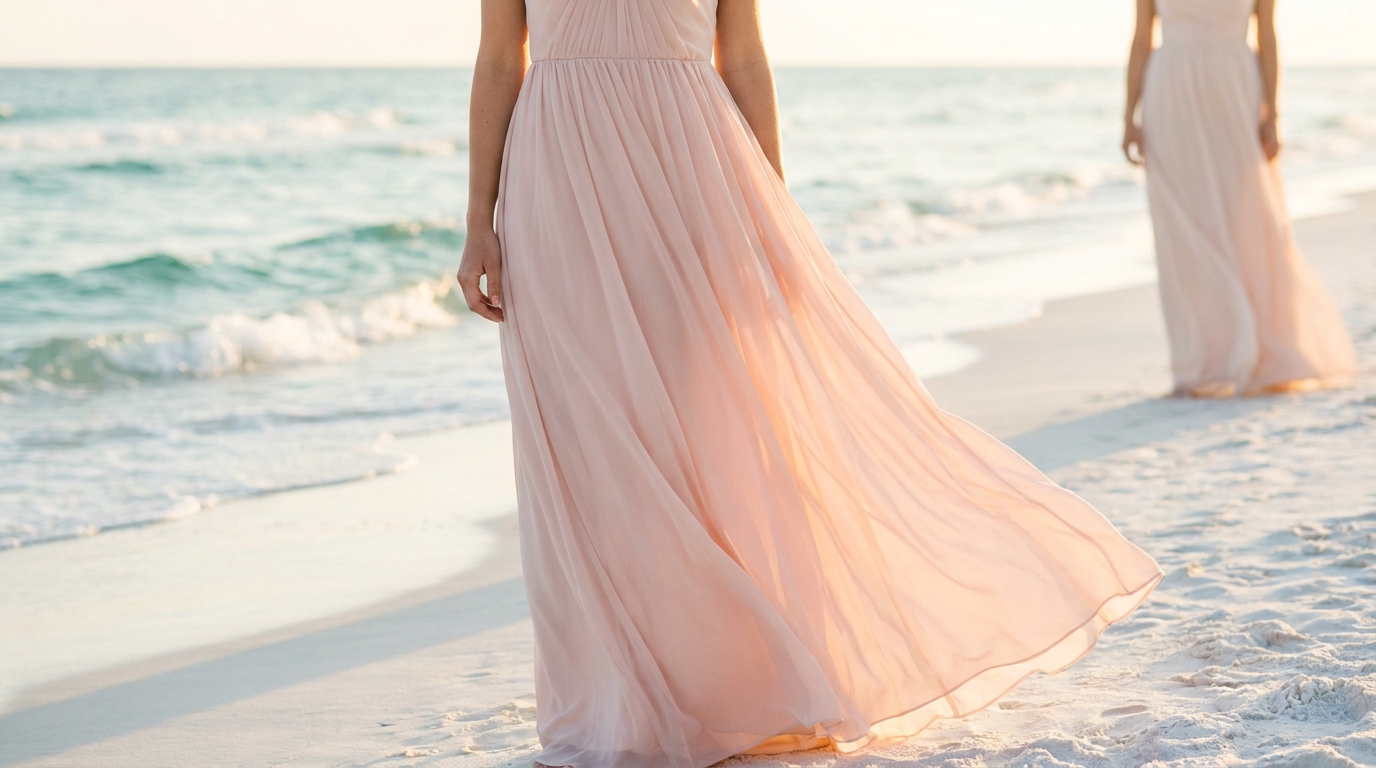
Chiffon, jersey knit, and crepe de chine resist wrinkles, pack compactly, and breathe well in warm climates. Polyester blends generally outperform natural fibers for travel durability.
Fabric is the single most important decision you’ll make for bridesmaid dresses for a beach wedding. The wrong material can turn a beautiful dress into a wrinkled, sweat-soaked disaster before the ceremony even starts.
Chiffon: Lightweight but Wind-Prone
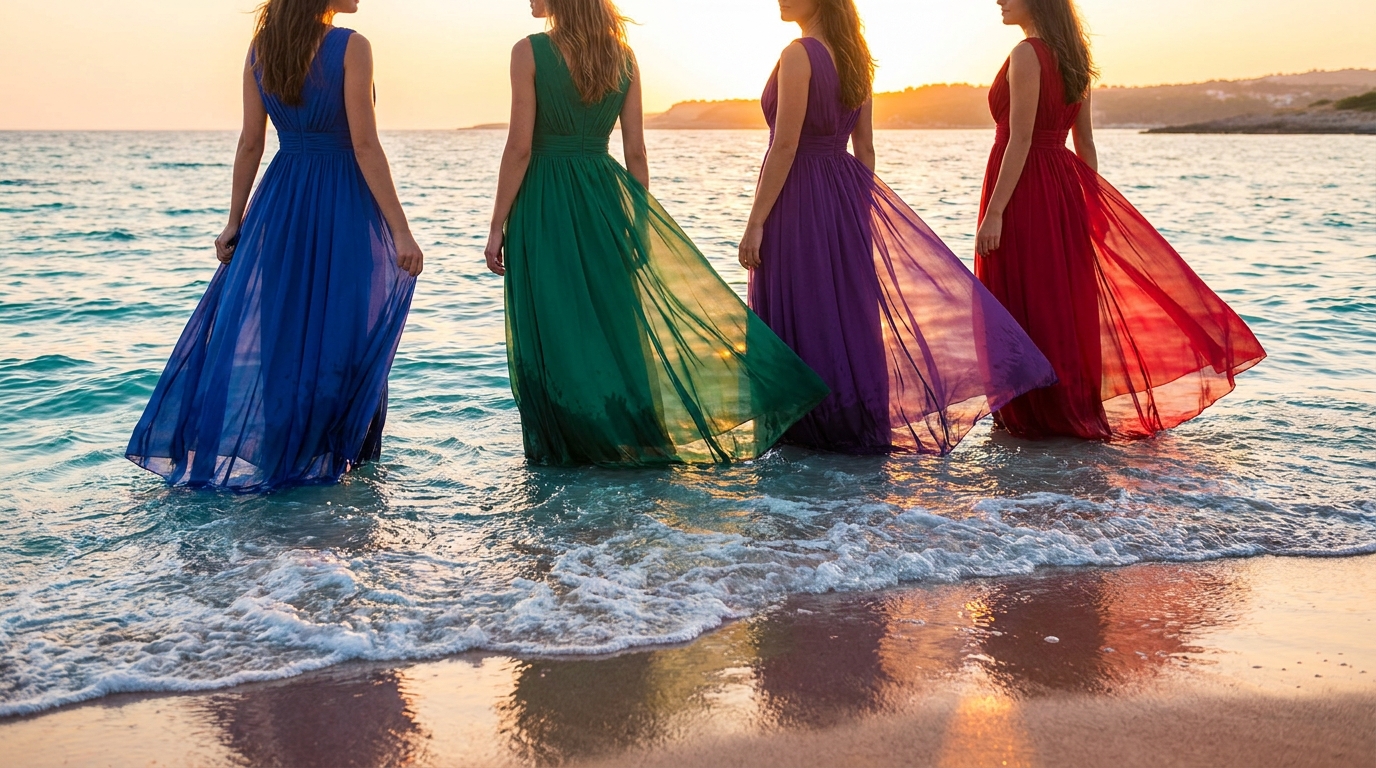
Chiffon is the most popular choice for destination bridesmaid dresses, and for good reason. It’s featherlight, drapes beautifully, and shakes out wrinkles with minimal steaming. The tradeoff? Wind. A beachfront ceremony with steady gusts will send chiffon skirts flying. If your venue is exposed, look for styles with a heavier chiffon weight or a lining that adds just enough structure to keep things under control. Azazie’s “Kailyn” and Birdy Grey’s “Chiffon Collection” both use a double-layered chiffon that handles wind better than single-ply options.
Jersey: Wrinkle-Proof but Clings in Humidity
Jersey knit is the ultimate travel fabric. You can ball it up in a suitcase corner and it’ll emerge looking pressed. The downside is that jersey clings, and humidity makes it cling more. For tropical destinations like Cancun or Jamaica, jersey works best in darker colors and relaxed silhouettes that don’t hug the midsection. BHLDN’s jersey wrap dresses are a solid option here.
Crepe: Structured Without Stiffness
Crepe sits in the sweet spot between chiffon’s flow and jersey’s resilience. It holds its shape, resists wrinkles reasonably well, and has enough weight to stay put in wind without feeling heavy. Jenny Yoo’s crepe-back satin styles (like the “Kayla”) give a polished look that photographs with more dimension than flat chiffon. Crepe also handles humidity better than most fabrics because it doesn’t absorb moisture as visibly.
Fabrics to Avoid: Taffeta, Organza, Heavy Satin
Taffeta wrinkles the moment you look at it sideways. Organza crushes in luggage and can’t be steamed back to life easily. Heavy duchess satin traps heat and shows every sweat mark. These fabrics were designed for climate-controlled ballrooms, not beachfront pavilions. If your heart is set on a satin look, opt for a lightweight charmeuse or crepe-back satin instead.
What Dress Styles Photograph Best at Beach and Tropical Destinations?
Flowing A-line and empire-waist silhouettes in saturated jewel tones or soft pastels photograph well against sand and water, while stark white or pale yellow tends to wash out in bright sunlight.
Over 70-80% of brides choose lightweight, flowy styles for beach ceremonies, according to aggregated industry data from leading bridal retailers and planners. [Source: Alison Bell Photographer] That’s not just a trend. It’s what works on camera.
Silhouettes That Move Well on Camera
Flowy midi and maxi dresses in lightweight fabrics dominate destination wedding photography for a reason: they create movement. A photographer capturing your bridal party walking along the shoreline gets dynamic, editorial-quality shots when fabric catches the breeze. Stiff, tight, or overly structured cuts look rigid and out of place against natural backdrops. Empire waists and A-lines are particularly forgiving because they skim the body without clinging, which means your bridesmaids look comfortable rather than posed.
Colors That Pop (and Colors That Disappear)
Coastal tones like sage, sea glass, dusty blue, and coral are the current favorites for destination bridal parties. These colors read well against both white sand and lush tropical greenery. Deep jewel tones (emerald, sapphire, burgundy) create striking contrast in golden-hour photos. What doesn’t work: very pale yellow, blush that’s too close to skin tone, and anything in stark white, which competes with the bride and blows out in direct sunlight. If you’re choosing pastels, lean toward muted, dusty versions rather than bright or icy shades. For full palette ideas that work against sand and water, see our guide to beach wedding colors.
Length Considerations: Midi vs. Floor-Length
Midi-length dresses (hitting between the knee and ankle) are increasingly popular for beach ceremonies because they keep hems out of the sand and surf. Floor-length dresses photograph beautifully but create practical problems: wet, sandy hems that drag and stain. If you love the floor-length look, consider a high-low hem or a dress with a slight train that can be bustled. For venues with uneven terrain, like cliffside ceremonies in Santorini or garden settings in Costa Rica, midi or tea-length is the safer bet.
How Should Bridesmaids Pack and Transport Their Dresses?
Roll dresses in tissue paper inside carry-on luggage, hang immediately upon arrival, and steam (never iron) wrinkles. Shipping directly to the resort costs $25-75 but eliminates packing stress entirely.
Roughly 0.5-0.7% of checked bags are mishandled globally per year, according to airline industry and IATA data. [Source: Molle Bridals] That’s a small percentage, but when the bag contains your bridesmaid dress for a wedding happening in 48 hours, it’s not a risk worth taking.
Carry-On vs. Checked Luggage
Carry-on is the strong recommendation. Experienced travelers on bridal forums report success with folding a garment bag in half, placing the dress inside a packing cube to prevent snags, and positioning it as the last item in a carry-on so nothing compresses it. [Source: Reddit] Turn the dress inside out, fold along seams, and roll gently rather than making sharp creases. For beaded or embellished styles, wrap in tissue paper to protect detailing. Some bridesmaids have also had success asking flight crew to hang a garment bag in an onboard closet, though this isn’t guaranteed.
Shipping Dresses to the Destination
Shipping directly to the hotel or resort is an underused option that eliminates packing anxiety. Most resorts will accept and hold packages for incoming guests. Expect to pay $25-75 for domestic shipping via USPS or UPS, more for international destinations. Ship at least two weeks before arrival, use tracking, and confirm with the resort’s concierge that they’ll store the package. This approach works especially well when bridesmaids are flying with tight carry-on limits or connecting through multiple airports.
On-Site Steaming and Pressing Services
Pack a portable travel steamer (they’re under $30 and weigh about a pound) or confirm that your resort offers pressing services. Most four- and five-star destination wedding resorts have laundry and pressing available, though turnaround times vary. Steam chiffon and crepe on a low setting, holding the steamer a few inches from the fabric. Never iron chiffon directly. Hanging the dress in a steamy bathroom for 20 minutes also works in a pinch.
What Do Destination Wedding Bridesmaid Dresses Actually Cost?
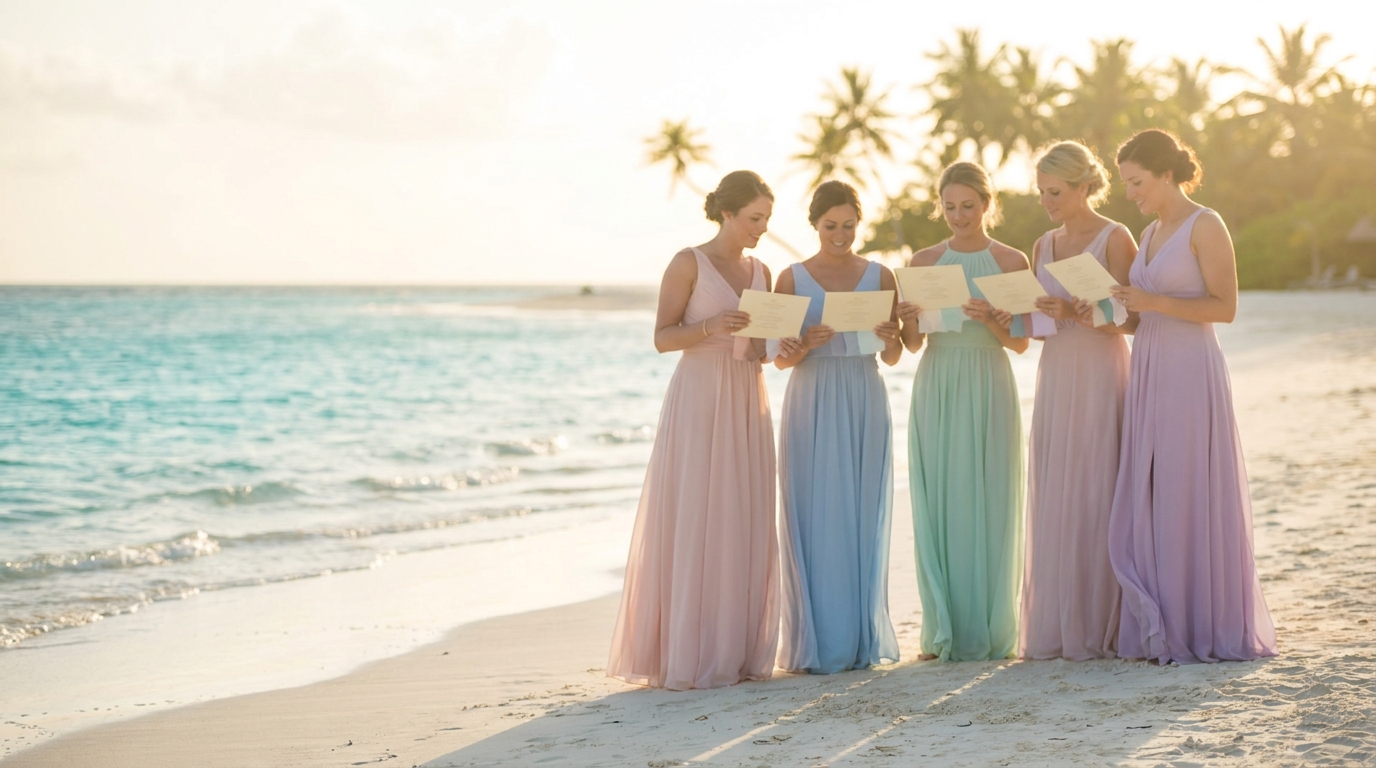
Expect $100-300 per dress from major retailers, with alterations adding $50-150. Budget-friendly brands like Azazie and Birdy Grey start around $69-99, while designer options can reach $400-800.
The Knot’s Real Weddings Study, surveying nearly 17,000 couples, reports an average bridesmaid dress cost of $128 per person, a figure that’s held steady since 2021. [Source: The Knot] Alterations typically add $50-150 per dress, bringing the realistic garment total to $150-450 per bridesmaid. [Source: Zola]
| Retailer | Price Range | Key Fabrics | At-Home Try-On | Return Policy |
|---|---|---|---|---|
| Azazie | $79-150 | Chiffon, mesh, satin, jersey | Yes (3 dresses, $10-15 each) | Returns within 10 days of delivery |
| Birdy Grey | $99-149 | Chiffon, crepe, mesh | Yes (free swatches; try-on dresses available) | Returns within 10 days, unworn |
| Revelry | $150-250 | Chiffon, tulle, sequin, velvet | Yes (try-before-you-buy boxes) | Sample returns within 7 days |
| BHLDN | $150-300 | Chiffon, crepe, georgette | No (in-store or order online) | Returns within 30 days |
| Jenny Yoo (via Dessy) | $250-350 | Chiffon, crepe-back satin, luxe knit | No | Varies by retailer |
| David’s Bridal | $69-180 | Chiffon, mesh, satin | No (in-store try-on) | Returns within 14 days |
Costs vary by style, size, and customization. Prices reflect standard retail at time of writing and may change.
Here’s the financial reality that doesn’t get discussed enough: bridesmaids attending a destination wedding often spend $1,000 or more per wedding once you add transportation, lodging, gifts, and pre-wedding events. [Source: Bella Bridesmaids] If you’re asking your bridal party to fly somewhere, covering the dress cost, or at least choosing a budget-friendly option, is a meaningful gesture. Brands like Birdy Grey and Azazie exist specifically to keep that line item manageable.
How Do You Coordinate Fittings When Bridesmaids Live in Different Cities?
Order from retailers offering at-home try-on programs, use detailed size charts with bust-waist-hip measurements, and allow 3-4 months minimum for shipping and local alterations.
At-Home Try-On Programs
Azazie, Birdy Grey, and Revelry all offer at-home try-on options that solve the scattered-bridal-party problem. Azazie ships sample dresses for $10-15 each (up to three at a time). Birdy Grey offers free fabric swatches and try-on dresses. Revelry sends try-before-you-buy boxes. These programs let each bridesmaid see the fabric, test the fit, and confirm the color in her own lighting before committing. Some retailers also offer coordinated “rooms” or group ordering portals so all dresses ship from the same dye lot, preventing color mismatches.
Virtual Fittings and Size Charts
Every bridesmaid should be measured by a professional tailor, not a friend with a tape measure, and should size according to the designer’s specific size chart rather than her usual retail size. [Source: Plan A Wedding] Assign one person, usually you or your maid of honor, to collect measurements, coordinate the order date, and confirm everyone has placed their order by the deadline. This single point of coordination prevents the “I thought someone else was handling it” problem that derails remote ordering.
Timeline for Ordering and Alterations
Made-to-order dresses typically take 2-3 months to produce. [Source: Bella Bridesmaids] Add time for shipping and local alterations, and you’re looking at a 4-6 month lead time. Rush orders are possible from most designers but add 15-20% to the dress price. For a destination wedding, build in extra buffer. If a dress arrives with an issue, you don’t want to be scrambling two weeks before you fly out.
Should You Choose Matching Dresses or Mix-and-Match Styles?
Mix-and-match styles in a unified color palette accommodate different body types and travel preferences while maintaining visual cohesion. Provide fabric swatches and length guidelines rather than rigid uniformity.
The data here is decisive: 62% of weddings now use some form of mix-and-match for their bridesmaids, up from 38% in 2023. [Source: Vow Launch] Over 69% of couples dress their wedding party in non-traditional outfits, which largely includes mismatched colors, prints, or silhouettes.
For destination weddings specifically, mix-and-match has practical advantages beyond aesthetics. A bridesmaid who runs hot can choose a sleeveless style. Someone self-conscious about her arms can pick a flutter sleeve. Your pregnant bridesmaid can order an empire waist while everyone else goes A-line. The key is giving clear parameters: same fabric, same color family, same general length. “Dusty blue chiffon, floor-length or midi, your choice of neckline” gives enough structure for cohesive photos while respecting individual comfort.
That said, about one-third of couples still prefer matching styles, and that’s completely valid. Matching creates a clean, uniform look that some brides prefer, especially for formal destination weddings. If you go the matching route, choose a universally flattering silhouette like a V-neck A-line and prioritize a fabric that works across body types.
What Accessories Work (and What Creates Problems) for Destination Bridesmaid Looks?
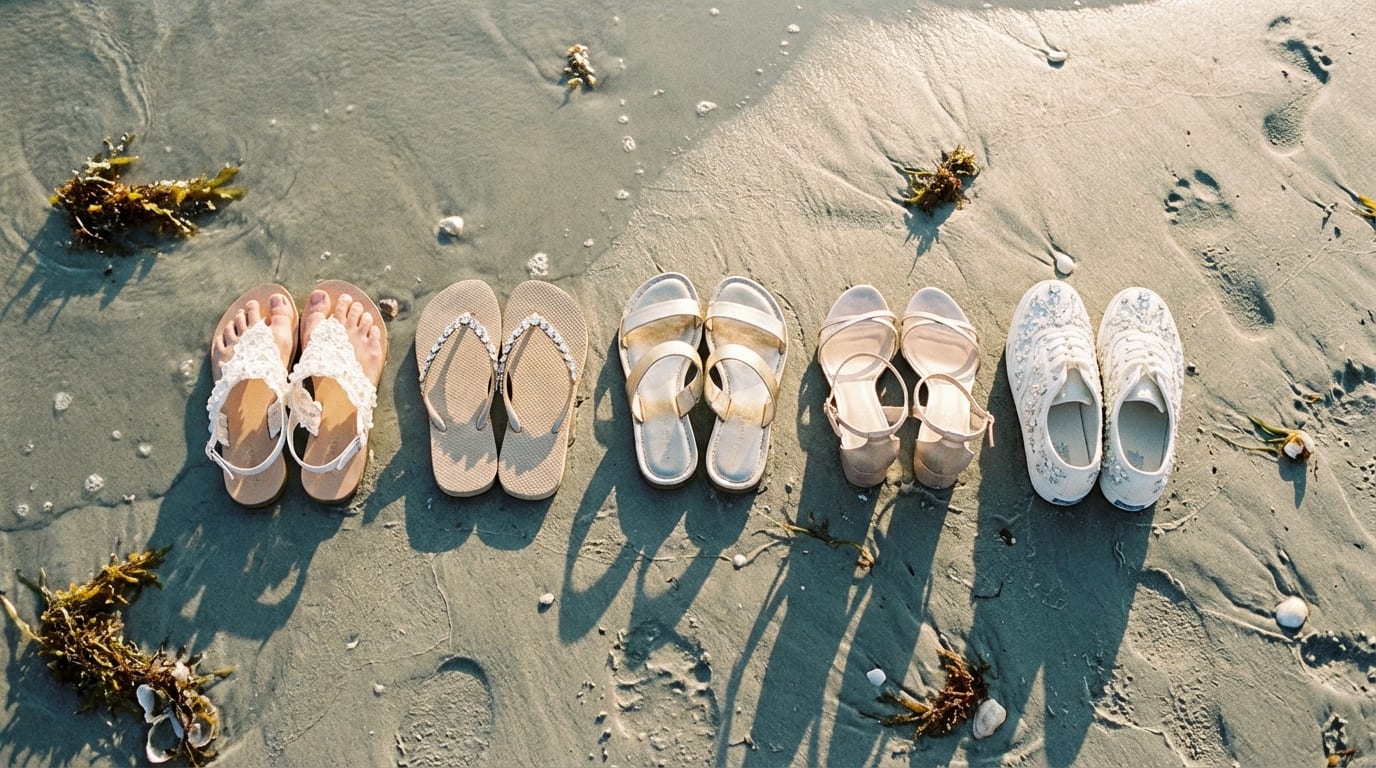
Flat sandals, minimal jewelry, and loose hair or simple updos suit beach settings. Avoid heels that sink in sand, heavy statement pieces that compete with scenery, and elaborate hairstyles humidity will destroy.
Risa Kostis, Wedding Emergency Stylist and co-founder of The Rescue Kit Company, puts it simply: “Aligning with the bride’s style and overall aesthetic of the wedding party, decor and location is crucial.” [Source: The Knot]
What works: One jewelry statement at a time, either earrings or a necklace, not both. Metallic or nude flat sandals that coordinate across different dress colors. A small clutch or wristlet for essentials. A pashmina or light wrap for cooler evenings, particularly useful at waterfront venues where temperatures drop after sunset. Azazie recommends allowing 6-8 weeks to coordinate accessories before the wedding date. For specific footwear picks, our roundup of beach wedding shoes covers the styles that actually hold up on sand.
What creates problems: Stiletto heels on sand or grass (they sink, they wobble, someone will twist an ankle). Big statement necklaces paired with detailed necklines that compete visually. Elaborate updos that humidity will dismantle within an hour. Heavily coordinated matching accessories can also feel overly rigid if you’ve intentionally chosen mismatched dresses. If you’re exploring beach wedding hair and makeup options, lean toward styles that embrace rather than fight the elements.